About Us
 Careers
 Leadership
 Board
 Newsroom

Home services search engine optimization (SEO) is the work you do to get your plumbing, heating, ventilation, and air conditioning (HVAC), or roofing company found when a homeowner searches for help. That search now happens in three places: the Google map pack, the organic results, and the single answer an artificial intelligence (AI) assistant gives.
The AI piece is no longer a side channel. Local Buying Behavior 2026 found 62% of consumers used AI to find a local business this year, and 31.3% booked an appointment from a single AI recommendation. When you’re running jobs all day, homeowners who can’t find you in those three places call a competitor instead.
This guide shows you how to get more customers from local search without adding hours to your week. It covers your Google Business Profile, reviews, site pages, keywords, technical fixes, AI recommendations, tracking, and a routine you can keep up with between jobs.
Get found on Google and in AI search with local SEO software
TL;DR
- Map pack rankings follow three Google factors: Google uses relevance, distance, and prominence to rank local results. A complete profile, steady reviews, and useful service pages are the levers you control.
- AI assistants lean on your own website: Gemini cites a recommended business’s own website 8 times out of 10, per Vendasta open beta research, so clear site content carries weight.
- Vendasta SEO AI handles the routine work: It syncs listings, tracks map rankings across your service area, and checks whether ChatGPT, Gemini, and Perplexity recommend you.
What SEO for Home Services Means in 2026
SEO for home services is one discipline that covers Google Maps, organic results, and AI assistants. Google’s local ranking help page says local results are mainly based on relevance, distance, and prominence. Prominence draws partly on how many reviews you have and how many websites link to you.
Those same signals feed AI assistants. A complete profile, consistent listings, and pages that answer real questions help Google rank you, and they give ChatGPT, Gemini, and Perplexity something specific to cite when a homeowner asks who to call. Two things set home services apart from other local businesses: urgent searches and the service-area business model.
How Home Services SEO Differs From General SEO
Home service searches are local and often urgent. A homeowner with a burst pipe at 2 a.m. scans three map results and calls the first plumber who looks open and trusted, without reading blog posts.
Most trades also run as service-area businesses that visit customers rather than serving them at a storefront. Google’s service area guidelines tell these businesses to remove their address from the profile if customers don’t come to them, and to list the cities or postal codes they cover instead.
Why AI Search Is Part of the Same Job
An AI assistant returns one recommendation instead of ten links, and customers act on it. That 31.3% booking rate from a single AI recommendation means the business named in the answer often gets the job without a homeowner ever comparing options.
Many businesses never get that chance. A Vendasta analysis of 210 local businesses’ brand visibility reports, April to October 2026, found 1 in 4 didn’t come up in a single AI answer.
Optimize Your Google Business Profile for the Map Pack
Your Google Business Profile is often the first thing a homeowner sees, before your website and before any conversation. Treat it as a storefront you manage every week, not a listing you set up once.
Google states that the categories you select affect your local ranking, and that businesses with complete, accurate information are more likely to show up. These are the fields to fill in:
- Categories: Pick the most specific primary category for your main service, then add secondary categories for the other work you do. Seasonal trades can test rotating the primary category: Sterling Sky describes an HVAC client that used “Furnace Repair Service” in winter and “Air Conditioning Repair Service” in summer.
- Hours: Add regular and holiday hours, plus 24/7 availability if you take emergency calls.
- Service areas: Google allows up to 20 service areas, set by city or postal code, within about two hours’ drive of your base. You can’t set a radius.
- Services: List each service with a description and price where possible.
- Photos: Upload real job photos, trucks, and crew shots. Google’s photo guidelines ask for images without significant alterations or heavy filters that represent reality.
- Posts: Share offers and updates regularly. Google archives posts older than six months unless you set a date range.
Answer common customer questions on your own website, because Google’s profile Q&A is changing. Google discontinued its Business Profile Q&A application programming interface (API) on November 3, 2025, which cut off the tools many businesses used to manage questions in bulk.
In December 2025, Search Engine Roundtable reported that Google confirmed it was removing Q&A from Google Maps in favor of an AI-powered Ask button, while owners could still answer existing questions on the back end.
The feature may not be gone for good. In August 2026, Search Engine Roundtable reported that Google seems to be testing a revamped Q&A feature for Business Profiles. Questions answered on your website stay under your control either way.
Build a Steady Stream of Google Reviews
Reviews are the prominence signal you can grow every week. Google says more reviews and positive ratings can help your local ranking, and AI tools lean on them too: Vendasta research found the businesses AI names most often have almost 7 times as many Google reviews as the ones it never names.
Ask every customer, by text, the day the job closes, so new reviews arrive at a steady pace instead of in one burst. Stay inside these rules when you ask:
- Incentives: Google bans discounts, payments, or free services in exchange for reviews.
- Selective asking: Google’s Maps content policy bans selectively soliciting positive reviews, so you can’t ask only happy customers.
- Fake and insider reviews: The Federal Trade Commission’s (FTC) Consumer Review Rule prohibits fake reviews, undisclosed reviews from company insiders such as employees, and review suppression.
- Google restrictions: Google can block new reviews or show a warning on a profile caught with fake reviews.
- FTC penalties: Courts can impose civil penalties for knowing violations of the FTC rule, up to $53,088 per violation, per the FTC’s business guidance blog.
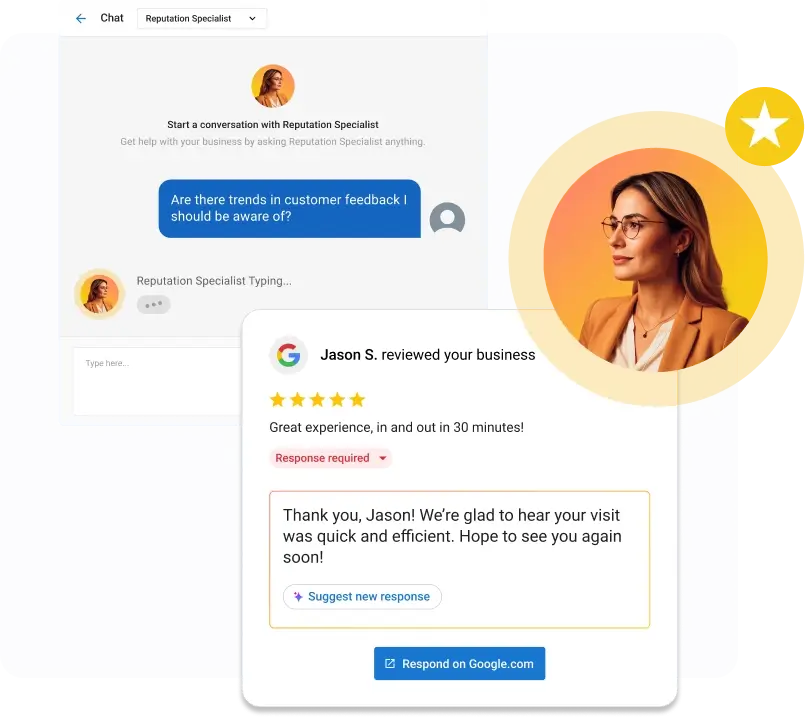
Reply to every review, good and bad, with specifics about the job. If replies fall behind on busy weeks, Vendasta’s AI Reputation Specialist can respond to reviews under rules you set.
Create Service Pages and Service-Area Pages That Convert
Build a hub-and-spoke site: one detailed page per core service, such as water heater replacement or drain cleaning, with town pages linked from a service-area hub. Each page should answer what you do, where, how fast, and what it costs.
A town page earns its place only when it has content no other page has. Google’s spam policies list pages targeted at specific cities that funnel users to one page as doorway abuse. The same policy covers substantially similar pages, so identical copy with only the city name changed, Tulsa on one page and Broken Arrow on the next, puts a site at risk.
Local job photos, reviews from customers in that town, permit notes, and typical pricing make a page unique. Put a click-to-call button and a booking link at the top of every page, because the emergency caller won’t scroll.
Target Emergency and Planned Searches With Local Keywords
Home service searches split into urgent queries that convert into calls and research queries that lead to bigger jobs later. Search Engine Land’s seasonality guide reports air conditioning repair searches spike in June, while furnace repair searches peak in October and stay elevated through fall and winter. Here is how the patterns line up by trade:
| Trade | Urgent searches | Research searches | Seasonal pattern |
|---|---|---|---|
| Plumbing | emergency plumber near me, burst pipe repair | water heater replacement cost | Frozen pipe calls rise in cold snaps |
| HVAC | AC repair near me, 24 hour HVAC [city] | how much does AC repair cost, when to replace furnace | AC peaks in summer; furnace peaks in fall |
| Roofing | roof repair near me, storm damage roof repair | roof replacement cost | Demand follows hail and storm events |
Put urgent terms on service pages and your profile, and use them the way homeowners do, including “near me” searches. Answer research terms on cost and FAQ pages.
Keep Listings Accurate and Fix Technical Basics
Your business name, address, phone number, and hours must match everywhere, from Google and Bing to Apple Maps and Facebook. Google says inaccurate information can keep a profile from showing up for relevant searches in your area.
Four technical fixes matter most for a trade site:
- Mobile speed: Google’s Core Web Vitals call a page good when Largest Contentful Paint is 2.5 seconds or less, Interaction to Next Paint is 200 milliseconds or less, and Cumulative Layout Shift is 0.1 or less.
- LocalBusiness schema: Use the most specific type, such as Plumber, HVACBusiness, or RoofingContractor, with name, phone, and hours.
- FAQ content: Google stopped showing FAQ rich results in May 2026, so FAQ markup won’t earn a special listing. Well-written questions and answers still help define your business for AI tools.
- Robots.txt: OpenAI’s crawler documentation says sites that opt out of OAI-SearchBot won’t be shown in ChatGPT search answers, and you can block training crawlers like GPTBot separately. Perplexity recommends allowing PerplexityBot so your site appears in its results.
Get Recommended by ChatGPT, Gemini, and Perplexity
Answer engine optimization (AEO) means making your business easy for AI tools to find, trust, and name. Vendasta open beta research found Gemini cites a recommended local business’s own website 8 times out of 10, so clear site content carries weight. The same research found ChatGPT, Gemini, and Perplexity all named the same business on only 1 in 5 questions, so you need to check each tool separately.
Use this AEO checklist:
- State services, service areas, hours, and emergency availability in plain text on your site.
- Publish FAQ pages that answer cost, timing, and “do you serve [town]” questions.
- Add LocalBusiness schema and allow AI search crawlers.
- Keep reviews coming and listings consistent.
Test it monthly. Ask each assistant “Who’s the best emergency plumber in Tulsa?” with your own trade and city, then note who gets named and which sources get cited.
Track Results in Calls and Booked Jobs
Measure SEO by the calls and booked jobs it produces. Google’s Business Profile performance report shows calls, direction requests, website clicks, searches, and bookings made through a booking provider.
Use separate tracking numbers for your profile, website, and ads so each call has a source. Add a rank grid for map positions, a monthly AI visibility check, and booked-job data from Jobber, Housecall Pro, or ServiceTitan to tie calls to revenue.
SEO builds over months, not days. Profile corrections, like fixing categories or service areas, can show up quickly, while gains from reviews, pages, and links compound over time, so compare SEO with ads and lead platforms by cost, speed, and lead ownership to choose the right mix.
Organic SEO vs. Google Ads, Local Services Ads, and Lead Platforms
Each channel trades cost against speed and control. Costs vary by market and change often. LocaliQ’s home services benchmarks put the 2025 average cost per click at $7.85, with plumbing at $10.49 and roofing and gutters at $10.70:
| Channel | Cost model | Speed | Lead ownership | Best fit |
|---|---|---|---|---|
| Organic SEO | Your time or a monthly retainer | Months | You own the traffic | Long-term call volume |
| Google Ads | Pay per click; about $7.85 on average for home services in 2025 | Days | Visitors land on your site | Filling gaps fast |
| Local Services Ads | Pay per valid lead; WordStream puts the average cost per lead at about $60 | After screening that averages 3–4 weeks | Leads arrive through Google | Urgent calls with a verified badge |
| Angi, Thumbtack, HomeAdvisor | Pay per lead; price varies by job type and market | Days | Leads arrive through the platform | Testing new service lines |
Local Services Ads are also changing. Google began moving them into Google Ads Performance Max campaigns in August 2026, starting with select U.S. home and storefront service advertisers, and they’re still billed per valid lead.
A Weekly SEO Routine for Busy Home Service Owners
A short, fixed routine keeps home service SEO moving without eating job time:
| Frequency | Tasks | Time |
|---|---|---|
| Daily | Reply to new reviews and messages | 5 minutes |
| Weekly | Request reviews from finished jobs, post a job photo, check profile edits | 30 minutes |
| Monthly | Review calls and booked jobs, run AI prompt tests, check the rank grid, improve one page | 1–2 hours |
| Quarterly | Audit listings, rotate seasonal categories, refresh town pages, check robots.txt and speed | Half a day |
If SEO marketing for home services won’t fit your week, hire help. Ahrefs’ SEO pricing poll found local SEO agencies typically charge $1,819 per month and freelancers around $1,150.
Google warns that no one can guarantee a #1 ranking. Keep your profile and ad accounts under your own Google login, ask where backlinks come from, and require monthly reports tied to calls and booked jobs.
How Vendasta SEO AI Handles Home Services SEO for You
Vendasta SEO AI, part of the Vendasta customer acquisition and engagement platform, is local SEO software that keeps listings accurate and rankings on track. It syncs your business name, address, phone number, and hours to Google, Facebook, Apple, Bing, Instagram, and X, so you don’t have to recheck each site every time your hours change.
Its local search grid shows where you rank block by block across your service area and how you compare with nearby competitors. For a plumber who covers a dozen suburbs, that shows which neighborhoods see you in the map pack and which ones send their calls elsewhere.
SEO AI also includes the AI Search Specialist, which checks and fixes search visibility gaps, fills in profiles, selects tracking keywords, and answers your questions in plain language.
What the AI Search Specialist Checks and Fixes
The AI Search Specialist, an AI Employee, checks whether ChatGPT, Gemini, and Perplexity recommend your business and shows which competitors appear instead. Its report on SEO and AEO health refreshes monthly, so you see the trend. After a hailstorm, a roofer might find a competitor named for “storm damage roof repair” instead.
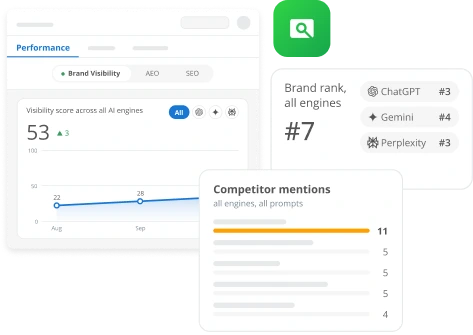
It then turns those gaps into work: FAQs, schema and robots.txt fixes, and blog content aimed at questions where AI isn’t recommending you yet. You approve each change with one click or let it run on its own. If a change breaks your site layout, it rolls back automatically.
Profiles, Keywords, and Plain-Language Answers
The AI Search Specialist fills in your profiles from your website, including services, service areas, payment options, description, and attributes, then updates every connected listing. It reviews Google’s suggested edits and picks 10 keywords worth tracking, based on impact and effort. You can ask it plain questions, such as what changed this month or which fix matters most.
Reviews influence which businesses AI recommends, so pair Vendasta SEO AI with Vendasta’s AI Reputation Specialist.
Home Services SEO Rewards the Business Google and AI Can Verify
The plumber, HVAC company, or roofer that gets the call is the one Google and AI tools can confirm: accurate listings, a complete profile, steady reviews, and pages that answer real questions. You can’t change your distance from a searcher, but you can improve relevance and prominence through work you do every week. Most of that work repeats, which makes it easy to hand to software while you run jobs.
Follow the weekly routine to keep those signals fresh, and track calls and booked jobs to see which searches turn into paid work on your calendar.
To see how Vendasta can address this workflow in your business, book a Vendasta demo.
Home Services SEO FAQs
1. What is home services SEO?
Home services SEO is the work of getting a plumbing, HVAC, roofing, or other trade business found in the Google map pack, organic results, and AI assistant answers. It covers your Business Profile, reviews, listings, website pages, local keywords, and technical setup, all aimed at turning searches into calls and booked jobs.
2. How do I get into the Google map pack for my trade and service area?
Complete your Google Business Profile with accurate categories, hours, services, photos, and up to 20 service areas. Collect reviews after every job and reply to them. Google ranks on relevance, distance, and prominence, so you can’t control distance, but you can strengthen the other two factors every week.
3. How do I get my business recommended by ChatGPT, Gemini, or Perplexity?
Publish clear service, area, and hours information on your website, add FAQ pages, use LocalBusiness schema, and allow AI search crawlers in robots.txt. Keep listings consistent and reviews coming. Then test each assistant monthly with a prompt like “best emergency plumber in [your city]” and see who gets named.
4. How do I get more Google reviews without breaking the rules?
Ask every customer, ideally by text the day the job closes, regardless of how you think it went. Never offer discounts or gifts for reviews, never ask only happy customers, and never post undisclosed reviews from employees. Google can restrict your profile, and courts can impose civil penalties for knowing violations of the FTC’s rule.
5. Should I build separate pages for each service and each town I serve?
Build one page for each core service. Add town pages only when you have unique local content, such as job photos, reviews from that town, permit notes, or local pricing. Near-identical pages with swapped city names can count as doorway abuse under Google’s spam policies and put your site at risk.
6. How long does home services SEO take to bring in calls?
There’s no fixed timeline, because results depend on your market, your starting point, and how consistently you do the work. Profile corrections, like fixing categories or service areas, can show movement quickly. Competitive markets and brand-new websites take longer, especially where nearby competitors already hold hundreds of reviews.
7. How much does SEO for home service companies cost?
Doing it yourself costs about 30 minutes a week plus a monthly review. Ahrefs’ poll found local SEO agencies typically charge about $1,819 per month and freelancers around $1,150. Prices vary widely by market, scope, and provider, so compare what each quote includes against calls and booked jobs.
8. Which SEO tasks should I do weekly or monthly while running jobs?
Each week, ask finished customers for reviews, share one job photo, and scan your profile for unwanted edits. Once a month, compare calls with booked jobs, run your AI prompt tests, look at the rank grid, and strengthen a single page. Every quarter, recheck listings, seasonal categories, speed, and robots.txt.
9. Should I do SEO myself or hire an agency?
Do it yourself if you can keep up the weekly routine, and hire help if you can’t. Walk away from anyone who guarantees rankings. Keep your accounts in your own name, ask where backlinks come from, ask for references from other trade clients, and require reports tied to calls and booked jobs.
10. Is SEO dead or evolving in 2026?
SEO is evolving. The same fundamentals that win the map pack, including accurate listings, reviews, and useful site content, now also decide which businesses AI assistants recommend. Because homeowners now ask AI assistants for local recommendations, the job includes checking those answers alongside Google rankings.