About Us
 Careers
 Leadership
 Board
Board Newsroom
Marketing automation for franchises becomes critical when your growth depends on how dozens of locations handle the same lead. You can invest in campaigns, generate demand, and drive traffic, but conversion is decided locally and often within minutes.
That is where the real breakdown happens. Calls go unanswered. Follow-ups are delayed. High-intent prospects lose interest before anyone reaches out. Research shows that businesses that respond to leads within 5 minutes are 21 times more likely to qualify them compared to those that wait 30 minutes.
Now multiply that gap across 50 or more franchise locations. The result is not just missed revenue, but inconsistent customer experiences across the brand.
The challenge is not generating leads. It is building a consistent system for what happens after the lead comes in.
This is where marketing automation for franchises comes in. It standardizes lead capture, follow-ups, and customer engagement so every location operates at the same level without constant oversight from headquarters.
This guide explores how franchise marketing automation works, why it matters for multi-location brands, and how leading franchise teams are using AI-driven systems to improve consistency and performance across every location.
Streamline operations and ensure brand consistency for franchise success
TL;DR
- Leads don’t convert themselves. Up to 30% of franchise leads never receive proper follow-up, creating a leaky bucket that no amount of ad spend can fix. Automation seals those gaps at every location, at scale.
- Set the standard once, deploy it everywhere. The best marketing automation platforms for franchise or multi-location businesses let the franchisor define the playbook while AI executes it consistently across every territory, 24/7.
- Vendasta’s AI Workforce was built for this. With AI voice, SMS, web chat, reputation management, and CRM automation in a single connected platform, Vendasta helps franchisors capture more leads, convert more customers, and finally gain visibility into what’s working across the network.
What Is Marketing Automation for Franchises?
Marketing automation for franchises is the use of technology to centrally define, deploy, and optimize marketing and lead-management processes across multiple franchise locations, without requiring manual intervention at each location.
Unlike single-location marketing automation, franchise automation must solve a fundamentally different problem: the tension between brand control at the franchisor level and execution at the local level.
Every franchisee needs some flexibility to engage their local market. And both need results they can actually measure.
Franchise marketing automation bridges that gap. It gives the home office the controls, the standards, and the visibility. It gives franchisees the tools to respond to leads, book jobs, manage their reputation, and engage customers, without needing a dedicated marketing team at every location.
What Does Franchise Marketing Automation Actually Cover?
Effective automation for multi-location franchise brands typically addresses:
- Lead capture: AI chat, voice, and web forms that collect inquiries 24/7
- Lead response and follow-up: Automated SMS, email, and phone outreach triggered immediately when a lead comes in
- Appointment booking and scheduling: Automated booking flows that convert leads into confirmed jobs
- Reputation management: Automated review requests, responses, and monitoring at the location level
- Social media publishing: Centrally approved content distributed across individual location profiles
- Local SEO and listings management: Ensuring every location’s contact info, hours, and details are accurate across all directories
- CRM and pipeline management: Capturing conversations, tracking lead stages, and surfacing opportunities automatically
- Reporting and analytics: Network-wide and location-level dashboards that show marketing ROI clearly
When all of these systems work together in a single platform, franchise brands stop losing leads in the gaps between tools and start building a consistent, scalable growth engine.

Why Franchise Marketing Automation Is No Longer Optional
The franchise model is built on replication. A franchisor’s greatest competitive advantage is the ability to deliver a consistent customer experience across dozens or hundreds of markets. That advantage only holds when every location operates to the same standard.
But here’s the challenge most franchise CMOs already know: you can standardize the product, the pricing, and the uniforms. Standardizing marketing execution, especially at the local level, is a different problem entirely.
The Leaky Bucket Problem
The biggest hidden cost in franchise marketing isn’t ad spend. It’s lead leakage.
Consider the typical franchise lead journey:
- A prospect searches for a service in their area
- They find your franchise, click an ad or listing, and submit a form or call
- At a busy franchisee location, that call goes unanswered or the form sits in an inbox
- The prospect calls your competitor and books with them instead
Industry data suggests that roughly 30% of inbound leads never receive a timely response. For home services franchises, where booking intent is high and patience is low, that number translates directly into lost revenue.
The problem compounds. Even leads that are captured often aren’t properly nurtured through the funnel. Franchises frequently have significant middle-of-funnel and bottom-of-funnel lead pools: people who inquired, got a quote, or scheduled a consultation but never booked a job. Without automated follow-up, those leads simply go cold.
No amount of additional ad spend fixes a leaky bucket. Automation seals the gaps.
Why Location-by-Location Management Doesn’t Scale
The instinct for franchise marketing teams is to address these problems manually: send best-practice guides, hire field marketing managers, or bring in an agency to follow up with underperforming locations directly. This works at 10 locations. It doesn’t work at 50, and it completely breaks down at 100+. The scaling ceiling is the same one agencies hit with marketing automation across a client roster — manual oversight stops working long before the account count does.
At scale, the only viable approach is to automate the standard. Define the playbook once, encode it into your systems, and let those systems execute it everywhere, consistently, without requiring oversight at each step.
That’s what modern automated workflows make possible.
The 7 Core Challenges Franchise Marketing Automation Solves
Understanding the specific pain points automation addresses helps franchise CMOs prioritize where to deploy it first.
1. Missed Calls and After-Hours Lead Loss
Many franchisees are owner-operators running lean. When a call comes in at 7 PM or on a weekend, there’s often no one available to answer. AI voice receptionists can answer every call instantly, 24/7, capture the lead’s information, answer common questions, and even book appointments, without any human involvement.

2. Inconsistent Follow-Up Speed and Quality
One franchisee follows up within minutes. Another follows up three days later, if at all. That inconsistency creates brand risk and massive performance variance across the network. Automated SMS and email sequences triggered immediately on lead capture eliminate that variability.

3. Middle-of-Funnel Lead Decay
Leads who inquired but didn’t book, requested a quote but didn’t confirm, or attended a consultation but went quiet are among the highest-value prospects in the franchise pipeline. They already know the brand. Automated nurture sequences keep those leads warm and bring them back to conversion without requiring any manual follow-up effort.

4. Reputation Management at Scale
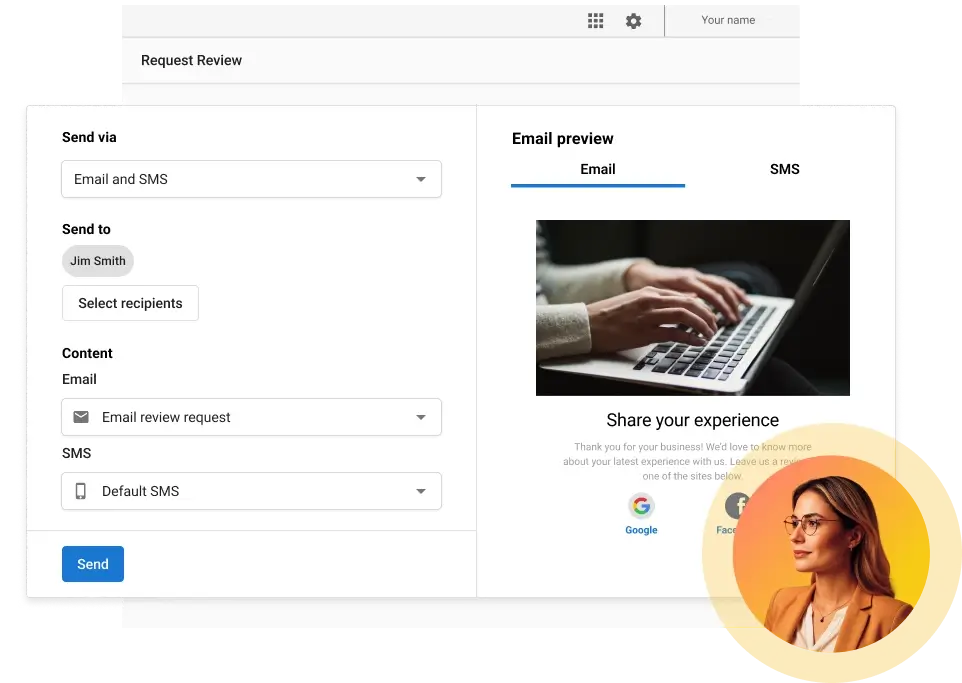
A franchise with 50 locations has 50 Google Business profiles to manage. Ensuring each one has recent reviews, accurate information, and timely responses to customer feedback is operationally impossible to do manually. Automated review requests, AI-generated responses, and centralized monitoring make multi-location reputation management scalable.
5. Brand Inconsistency in Local Marketing
When franchisees create their own local social posts, emails, or promotions without oversight, the result is often off-brand, off-message, or outright damaging. Centralized content libraries, pre-approved templates, and automated publishing workflows for multi-location businesses give franchisees the flexibility to act locally while staying within brand guardrails.
6. Siloed Data Across Systems and Locations
When each franchisee uses different tools, a different CRM here, a different scheduling system there, a different review platform somewhere else, network leadership has no unified view of performance. Consolidating into a single platform gives leadership the network-wide visibility they need to make smart decisions.

7. Franchisor Accountability Without Franchisor Control
Franchisees expect support from the home office to drive their success. When marketing performance is poor at a location, the tension often comes down to: is this a franchisor problem (quality of leads, creative, campaigns) or a franchisee problem (follow-up speed, booking process, local execution)? Unified automation with location-level reporting answers that question definitively.

Best Marketing Automation Platforms for Franchise Businesses
Not all marketing automation platforms are built to handle the complexity of multi-location franchise operations. Here’s an honest look at the leading options franchise brands are using today.
1. Vendasta: The AI-Powered Platform Built for Franchise Scale
Vendasta is the strongest all-in-one option for franchise brands because it’s built specifically to support multi-location marketing at scale. While most platforms handle one or two pieces of the franchise marketing puzzle, Vendasta brings together AI-powered lead capture, follow-up automation, reputation management, local SEO, social publishing, and CRM in a single connected platform.

What sets Vendasta apart for franchise use is its AI Workforce: a suite of specialized AI employees that handle the tasks franchisees either can’t do consistently or don’t have time to do at all.
Key capabilities for franchise brands:
- AI Receptionist (Voice and Chat): Answers calls and web inquiries 24/7, captures lead information, answers questions, and books appointments without human intervention. This is the direct solution to after-hours lead loss and missed calls across the network.
- AI SMS Campaigns via Conversations AI: Automated outreach sequences that engage leads immediately on capture, nurture mid-funnel prospects, and re-engage cold leads, all triggered by behavior and delivered at scale.
- Conversations AI: A centralized intelligent engine connecting phone, SMS, WhatsApp, and web chat, with documented results showing a 372% increase in lead-to-revenue conversion for brands that deploy it.
- AI Reputation Specialist: Sends automated review requests to customers post-service, generates personalized AI responses to reviews, and surfaces reputation trends at the location level. No manual effort required.
- CRM AI with AI Sales Assistant: A self-updating CRM that captures conversation outcomes, automates data entry, and surfaces pipeline opportunities automatically, so franchisees and the home office always have a clean, current view of where leads stand.
- Social AI: Centrally managed social publishing across all location profiles, with the ability to push approved content to individual franchisee accounts while maintaining brand consistency.
- Local SEO and Listing Sync: Keeps each location’s business information accurate across Google, Bing, Facebook, and other directories, improving local search visibility and reducing the time franchisees spend manually managing profiles.
The franchise advantage: Vendasta lets the franchisor set the automation standard once and deploy it across every location simultaneously. Franchisees get a single branded hub where they can see their performance, engage with leads, and take action, while brand leadership retains full visibility and control over network-wide standards.
Best for: Franchise brands in home services (lawn care, HVAC, cleaning, painting, junk removal, electrical) and other service-based verticals with 20+ locations and a centralized marketing team.
2. HubSpot

HubSpot is a widely used CRM and marketing automation platform that handles email marketing, lead scoring, workflow automation, and reporting. Franchise brands often use HubSpot for their franchisor-level marketing operations and lead nurture campaigns.
Where it works well: Top-of-funnel lead nurture, centralized email campaigns, and reporting on marketing-qualified leads.
Franchise limitations: HubSpot isn’t purpose-built for multi-location management. Giving individual franchisees meaningful access without creating data governance issues requires significant configuration. It also doesn’t include AI voice, automated review management, or local SEO tools natively. Most franchise brands using HubSpot still need additional tools to cover those gaps, adding cost and integration complexity.
3. Mailchimp

Mailchimp is a popular email marketing platform with basic automation capabilities. It’s accessible, affordable, and effective for brands running centralized email campaigns.
Where it works well: Broadcast email campaigns, simple automated drip sequences, and basic audience segmentation.
Franchise limitations: Mailchimp is a point solution for email. It doesn’t handle calls, SMS, review management, social publishing, or local SEO. For franchise brands with complex multi-location needs, it typically becomes one of many disconnected tools in the stack rather than a central platform.
4. Hootsuite

Hootsuite social media management platforms allow franchise brands to manage multiple location accounts from a single dashboard, schedule posts, monitor mentions, and set up basic automation.
Where they work well: Centralized social publishing, content scheduling, and social listening across location accounts.
Franchise limitations: Social is only one channel. Neither platform handles lead response, AI communication, booking automation, reputation management, or CRM. They solve one piece of the franchise marketing puzzle while leaving the rest to other systems.
5. Birdeye

Birdeye focuses on reputation management and customer communication, with features like automated review requests, review response tools, and messaging.
Where they work well: Review generation, SMS communication with customers post-service, and basic webchat.
Franchise limitations: These are strong point solutions for reputation and messaging but don’t provide the full-funnel automation franchise brands need. Adding them to an existing tech stack often creates another silo rather than solving the fragmentation problem.
Franchise Marketing Automation Platform Comparison
| Capability | Vendasta | HubSpot | Mailchimp | Hootsuite | Birdeye |
| AI Voice Receptionist (24/7) | ✅ | ❌ | ❌ | ❌ | ❌ |
| AI Web Chat | ✅ | Partial | ❌ | ❌ | ✅ |
| Automated SMS Follow-Up | ✅ | Partial | ❌ | ❌ | ✅ |
| Reputation Management | ✅ | ❌ | ❌ | ❌ | ✅ |
| Local SEO and Listings | ✅ | ❌ | ❌ | ❌ | Partial |
| Social Media Publishing | ✅ | Partial | ❌ | ✅ | ❌ |
| CRM and Pipeline Management | ✅ | ✅ | ❌ | ❌ | Partial |
| Multi-Location Dashboard | ✅ | Partial | ❌ | ✅ | Partial |
| AI-Powered Automation | ✅ | Partial | ❌ | ❌ | Partial |
| Single Unified Platform | ✅ | ❌ | ❌ | ❌ | ❌ |
How to Implement Marketing Automation Across a Franchise Network: A Step-by-Step Approach
Rolling out automation across 50+ locations isn’t a flip-the-switch exercise. Here’s a practical framework that franchise CMOs and VP-level marketing leaders can use to build a scalable, governed automation system.
Step 1: Audit Your Current Lead Journey
Before deploying any automation, map out what actually happens to a lead at a typical franchisee location today.
Ask: Where do leads come in? What happens within the first five minutes? Who follows up, how, and when? What happens to leads who don’t book? Where do leads fall out of the funnel?
This audit will reveal exactly where the leaks are and where automation will have the highest immediate impact.
Step 2: Standardize the Playbook Before You Automate It
Automation scales whatever process you put into it. If the process is broken, automation will scale the broken process. Before selecting tools, agree on the standard:
- What is your target lead response time? (Best practice: under five minutes)
- How many follow-up touchpoints should a lead receive if they don’t respond?
- What review request cadence should every location follow?
- What social content should go out at the location level, and how often?
Document these standards. They become the blueprint for your automation configuration.
Step 3: Choose a Platform That Covers the Full Funnel
Resist the urge to solve one problem at a time with point solutions. Each new tool you add to the stack is another integration to manage, another login for franchisees to adopt, another data silo for the home office to reconcile.
The best marketing automation platforms for multi-location businesses consolidate lead capture, response, nurture, reputation, social, SEO, and reporting into a single system. This is the single most important decision in the implementation process. Get this right and everything else becomes simpler.

Step 4: Configure Centrally, Deploy Locally
Set up your automation workflows, templates, and rules at the franchisor level. This includes:
- AI receptionist scripts and call handling logic
- SMS and email follow-up sequences
- Review request timing and message templates
- Social content calendars and publishing rules
- CRM pipeline stages and lead assignment rules
Once configured centrally, these standards deploy to every location automatically. Franchisees don’t need to build their own systems. They inherit a working playbook on day one.

Step 5: Give Franchisees Visibility, Not Complexity
One reason franchisees resist marketing technology is complexity. The interface is overwhelming, the onboarding is minimal, and the perceived benefit isn’t immediate.
The right platform gives each franchisee a simple, branded dashboard that shows them: how many leads came in, how many were responded to, how many jobs were booked, and how their reviews look. That transparency drives adoption because franchisees can see the system working for them.
Step 6: Measure Network-Wide Performance and Optimize
Once automation is running, the home office finally has the data to answer the hard questions:
- Which locations are converting leads at the highest rate, and what’s their secret?
- Which locations have the most missed calls or slowest follow-up? Where do they need support?
- Which campaign types are driving the best cost-per-booked-job across the network?
Use this data to run quarterly reviews, identify coaching opportunities, and continuously improve the standard you’ve set.
Key Marketing Automation Strategies for Franchise Growth
Beyond selecting the right platform, the following strategies determine whether automation delivers real business impact or just operational convenience.
Automate the First 60 Minutes After Lead Capture
The fastest ROI in franchise lead management comes from automating the immediate post-capture window. The moment a lead submits a form, calls in, or chats with your AI receptionist, your system should:
- Acknowledge the inquiry instantly via SMS or email confirmation
- Attempt an AI-assisted response within seconds through chat or voice
- If the lead is unreachable, initiate a follow-up sequence: call attempt, SMS, and email
- Notify the franchisee of a hot lead requiring personal attention
This sequence, fully automated, runs 24/7 across every location with zero involvement from the marketing team.
Use Behavioral Triggers to Re-Engage Mid-Funnel Leads
Your biggest untapped revenue opportunity may already be in your database. Leads who requested a quote but didn’t schedule, or scheduled a consultation but didn’t book, are strong conversion candidates. They know you. They just need a nudge.
Automated behavioral triggers can identify these leads and send targeted messages: a limited-time offer, a reminder of the service they inquired about, or a simple “Are you still looking?” text that re-opens the conversation.
Build Reputation Velocity into Every Service Interaction
A franchise’s online reputation is one of its most powerful local marketing assets. Locations with more, better, and more recent reviews consistently outperform those without in local search results.
Automate the review request: send an SMS or email to every customer 24 to 48 hours after service completion, link directly to your Google Business Profile, and let the AI Reputation Specialist handle responses. Across a 50-location network, this compounds into thousands of additional reviews per year with no manual effort.

Centralize Content, Localize Delivery
Social proof and local content matter in home services markets. But asking every franchisee to produce their own social content is a recipe for brand inconsistency.
The right approach: the franchisor creates a content calendar with approved posts, images, and captions. Automation distributes those posts to each location’s social profiles on schedule, with optional localization for city names, phone numbers, or local offers. Franchisees stay visible and on-brand without touching a publishing tool.
Track Conversion by Source, Not Just by Location
Most franchise dashboards show lead volume by location. The more valuable view shows lead-to-booked-job conversion by source: which campaigns, channels, and messages are actually turning into revenue?
When your automation platform captures data from first touch through booking, you can attribute revenue back to specific marketing activities. This is the data that justifies marketing budgets and helps the home office double down on what’s working.

What to Look for in a Franchise Marketing Automation Platform
When evaluating tools for franchise marketing automation, here are the criteria that matter most at scale.
Multi-Location Management Architecture
The platform must be designed from the ground up for multi-location use. That means a hierarchical structure where the franchisor can see and manage all locations, regions can be segmented, and individual franchisees have access only to their own data and settings.
AI-Powered Lead Response, Not Just Automated Email
The fastest-growing franchise brands are moving beyond simple email automation to AI-powered voice and chat that can handle lead inquiries in real time, any time. Look for platforms that include AI receptionist functionality, not just email drip campaigns.
Consolidated Reporting Across the Network
You should be able to see, in a single view, how many leads came into the network today, how many were responded to within five minutes, how many resulted in booked jobs, and how those numbers compare to last month. If your platform requires manual reporting to get this view, it’s not built for franchise scale.
Integration With Existing Franchise Tech
No platform exists in isolation. Your marketing automation system needs to work with your franchise management system, your payment processing, your scheduling tools, and potentially your call center. Evaluate integration capabilities carefully before committing.
Franchisee Adoption Simplicity
A platform that only 40% of franchisees actively use is delivering 40% of its potential value. The best franchise marketing automation platforms are simple enough that franchisees actually log in, look at their dashboards, and take action on what they see.
How Vendasta Solves the Franchise Marketing Automation Problem End to End
For franchise brands looking to consolidate their vendor stack, standardize marketing execution, and finally get clear ROI visibility across the network, Vendasta’s platform is purpose-built to deliver.
Here’s how the core Vendasta capabilities map to the most pressing franchise pain points:
Pain: Franchisees miss calls and lose leads after hours.
Solution: Vendasta’s AI Receptionist answers every call and chat inquiry, 24/7, captures lead details, answers questions, and books appointments without human intervention.

Pain: Inconsistent follow-up speed creates uneven performance across the network.
Solution: Conversations AI triggers automated, personalized follow-up sequences the moment a lead is captured, standardizing response speed across every location simultaneously.

Pain: Mid-funnel and bottom-of-funnel leads aren’t converting.
Solution: Conversations AI manages ongoing lead communication across phone, SMS, WhatsApp, and chat, nurturing prospects through the funnel with documented results of up to 372% increases in lead-to-revenue conversion.
Pain: Reputation management is impossible to do consistently at scale.
Solution: Vendasta’s Reputation AI automates post-service review requests, generates personalized review responses, and surfaces reputation insights at the location level, without any manual effort from franchisees or the marketing team.

Pain: Siloed data means network leadership can’t see what’s actually happening.
Solution: Vendasta’s unified platform gives brand leadership a network-wide view of lead volume, response rates, booking rates, and marketing ROI, while giving each franchisee their own location-level performance dashboard.
Pain: Too many vendors, too many tools, too much complexity.
Solution: Vendasta consolidates AI voice, SMS, web chat, reputation management, local SEO, social publishing, and CRM AI into a single platform. One vendor relationship. One integration. One place where franchisees manage their local marketing.

The Bottom Line: Set the Standard Once, Deploy It Everywhere
The franchise brands pulling ahead aren’t necessarily spending more on marketing. They’re converting more of the leads they already have, and they’re doing it consistently across every location in their network.
Marketing automation for franchises is the mechanism that makes that consistency possible at scale. It’s the difference between hoping every franchisee follows the playbook and knowing every location is executing it, because your systems enforce it automatically.
The franchisor sets the standard. AI enforces it everywhere. Franchisees get the results.
If your franchise network is ready to stop losing leads in the gap between marketing and operations, Vendasta was built to close that gap. From the first missed call to the fifth follow-up text to the review that brings the next customer in, the entire customer journey runs on automation, on brand, on time, every time. See how Vendasta helps franchise brands standardize excellence across every location. Book a demo today!
Marketing Automation for Franchises FAQs
1. What is marketing automation for franchises?
Marketing automation for franchises refers to using technology to standardize, deploy, and optimize marketing and lead management processes across multiple franchise locations. It allows the franchisor to define the marketing playbook once, then automate its execution at every location, ensuring consistency without requiring manual oversight at each site.
2. How does marketing automation help franchise businesses capture more leads?
Automation tools like AI voice receptionists and web chat capture lead inquiries 24/7, including after hours when franchisees may be unavailable. Automated follow-up sequences ensure every lead receives a timely, consistent response. Together, these tools reduce lead leakage and increase the percentage of inbound inquiries that convert into booked appointments.
3. What is the biggest marketing challenge for franchise brands?
One of the most significant challenges is inconsistent lead follow-up across locations. Industry data suggests that up to 30% of inbound leads never receive a timely response, particularly after hours. This creates both direct revenue loss and performance variance across the network that the franchisor’s marketing team struggles to address location by location.
4. What should I look for in a marketing automation platform for my franchise?
Look for a platform designed for multi-location management, with AI-powered lead capture and follow-up, consolidated network-wide reporting, reputation management automation, and local SEO capabilities, all in a single system. Vendasta offers all of these in one connected platform built specifically for franchise and multi-location brands.
5. Can marketing automation help improve franchisee satisfaction and retention?
Yes. Franchisee satisfaction is closely tied to their ability to generate revenue from their location. When automation handles lead capture, follow-up, and booking consistently, franchisees see better performance numbers. That improved performance translates into higher franchisee confidence, stronger relationships with the home office, and lower churn within the network.
6. How does AI fit into franchise marketing automation?
AI takes franchise automation beyond simple rule-based workflows. AI-powered tools like Vendasta’s AI Receptionist and Conversations AI can handle real conversations with leads, answer questions, and book appointments without human involvement. AI also powers reputation management responses, content insights, and CRM data updates, making automation more intelligent and more responsive to individual lead behavior.
7. What is the best marketing automation platform for franchise or multi-location businesses?
The best platform depends on your network’s specific needs, but for franchise brands in home services and other service verticals, Vendasta consistently stands out. It combines AI voice, SMS, chat, reputation management, local SEO, social publishing, and CRM into a single platform designed for multi-location deployment, giving both the franchisor and franchisees the tools they need in one place.
8. How long does it take to implement marketing automation across a franchise network?
The timeline depends on network size and the complexity of existing systems, but the most efficient implementations follow a centralized-then-deploy model: configure automation standards at the franchisor level and push them to all locations simultaneously. Platforms like Vendasta are designed to support this model, significantly reducing the time and resources required compared to location-by-location rollouts.
9. Do franchisees need technical expertise to use marketing automation tools?
No. The best franchise marketing automation platforms are built for simplicity at the location level. Franchisees access a simple dashboard showing their leads, bookings, reviews, and performance. The complex automation runs in the background. Vendasta’s franchisee interface is designed for adoption: clear, branded, and actionable without requiring any technical knowledge.
10. How does marketing automation help the franchisor prove marketing ROI to franchisees?
Automation platforms with consolidated reporting allow the home office to show franchisees exactly what their marketing investment is delivering: how many leads came in, how many were followed up with, how many booked jobs, and what the cost per acquired customer looks like. This transparency builds trust, justifies marketing fees, and makes the franchise system more accountable at every level.