 About Us
 Careers
 Leadership
 Board
 Newsroom
Reputation management for small businesses decides who gets the call, and 74.5% of small businesses in Vendasta’s 2026 State of Reputation Management report say it is critically important.
For a local service business, reputation management means asking every finished customer for a review. It also means replying to each review within a day or two and watching the listing and review sites where your business appears. You can run all of it without an agency. LocalImpact’s survey found that the owner personally manages reviews in 51% of local businesses.
An owner with no software budget can start this week:
- Claim and verify your Google Business Profile.
- Ask every customer (or, for a law firm, every closed client) for a review at job close, using your profile’s review link.
- Keep a three-line reply template that thanks the customer, addresses the specific issue, and offers a phone number.
- Run a weekly 10-minute check of the listing sites where you appear, and set a free Google Alerts notification for your business name to catch brand mentions.
A homeowner with a leaking water heater compares two plumbers at 9 p.m., sees a one-star review with no reply on one profile, and calls the other.
Automating requests and replies is how a one-truck business keeps its review profile current. The owner sets the rules once and approves only the replies that need judgment.
Grow reviews, boost visibility, and uncover insights with AI
TL;DR
- 74.5% of small businesses say reputation management is critically important: Yet 62.6% still rely mainly on native review platforms, logging into Google and Facebook one at a time, according to Vendasta’s 2026 State of Reputation Management report.
- Owners still run reviews by hand: LocalImpact’s survey found 51% of businesses leave reviews to the owner and only 23% automate review requests.
- Small businesses want automation with control: 56.2% are comfortable with automated review replies under set rules or thresholds. Vendasta’s AI Reputation Specialist replies to Google and Facebook reviews under your rules, and Reputation AI monitors 100+ sources.
Why Reputation Management for Small Businesses Is Now Mission-Critical
Vendasta’s 2026 State of Reputation Management report puts the stakes in owners’ own words: 74.5% of small businesses call online reputation management critically important, and another 15.6% call it very important. Only 1.3% say it is slightly important or not important.

A one-star rating increase raised independent restaurant revenue 5–9% in Luca’s working paper, which matched Yelp ratings to Washington State revenue records and found the effect for chains close to zero. No comparable study covers home services, but the inference is reasonable: for independents, the rating does work a brand name does for chains.
Reviews also feed ranking. Local Falcon’s analysis found the median plumber in Google’s 3-Pack had 215 reviews. Local Falcon labels this correlation, not causation, but the median gives a benchmark for that trade.
Google’s guidance says more reviews and positive ratings can help local ranking, and customers apply a screen of their own. BrightLocal’s consumer survey, published by a review-software vendor, adds a consumer floor:
- 47% of consumers will not use a business with fewer than 20 reviews.
- 68% require four stars or better.
- 74% only care about reviews from the last three months.
A roofing company with 15 reviews, the newest a year old, fails the review-count and recency tests before anyone reads a word about the work.
The 2026 Reputation Reality: Small Businesses Are Managing Reviews Manually
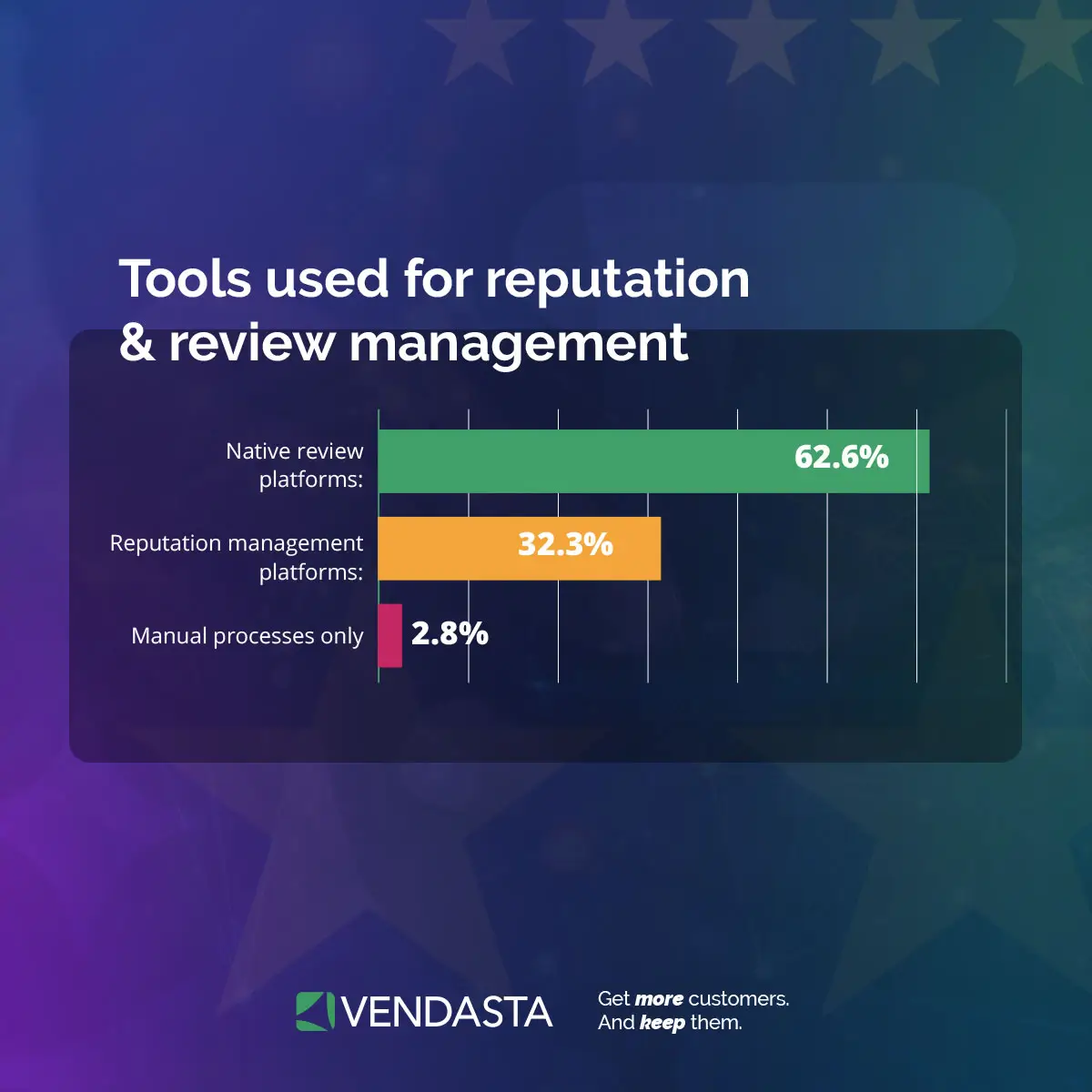
Vendasta’s 2026 State of Reputation Management report found 62.6% of small businesses rely primarily on native review platforms: logging into Google separately, checking Facebook independently, and replying to one review at a time with no central view. Only 32.3% use a dedicated reputation management platform, and 2.8% rely on manual processes alone.
Search Engine Land’s guide says nearly all local businesses benefit from a single organized reputation dashboard, and that managing every task by hand is “the exception rather than the rule,” workable only for local businesses with few reviews. LocalImpact’s vendor survey shows the owner is still the reputation department in 2026:
- 51% of businesses leave review management to the owner.
- 5% assign it to no one.
- 20% handle reviews with no software at all.
Only 45% train staff on how to handle a review, and 20% provide no training. So when the owner is on a job, nobody else knows how to answer.
In the same survey, 47% of owners check reviews daily, yet 45% take one to two days to respond and only 34% reply within a few hours. You read the review on your phone between jobs and answer it, if at all, that night or the next.
Why This Is Risky
Google’s guidance says replying to reviews can help a business stand out, yet UENI’s data suggests owners answer negative reviews last: in the vendor’s analysis, only 9.8% of one-star Google reviews received a reply, against 29.3% of five-star reviews. The one-star replies that did arrive took 19.5 days on average. The owner thanks a happy customer on a slow Sunday and leaves the complaint unanswered.
Search Engine Land’s guide treats replying to reviews as standard practice for local businesses, and BrightLocal’s survey shows consumers expect it: 89% of consumers expect owners to respond, and 81% expect a reply within a week. Another 42% are unlikely to use a business that never replies. Every prospect who reads that profile before you reply sees the complaint with no answer.
What Makes Reputation Management Different for Small Businesses vs. Enterprises?
A local service business has one location and nobody to delegate to, while an enterprise has dedicated staff and a larger budget per location. Enterprise reputation management software is built to cover many locations at once; a one-location trade needs less.
Two differences change what a one-location trade should buy:
- Rating sensitivity: As Luca’s restaurant data suggests, an independent’s rating carries more weight than a franchise’s.
- Voice and setup: Your replies carry your name, and customers who met you on the job can tell when a reply sounds like a call center. Premium enterprise platforms are typically quote-based with annual contracts. You need something that works with the field software you already use, such as Jobber, and fits in the gap between jobs without adding a login you will forget by Thursday.
Which Reputation Management Companies Fit a Local Service Business?
The best reputation management company depends on your location count, your review volume, and the field software you already run.
| Option | Intended user | Primary strength | Meaningful limitation | Best fit |
|---|---|---|---|---|
| Vendasta | Local service businesses and their partners | Reputation AI monitors 100+ sources, analyzes sentiment and sends review requests; AI Reputation Specialist replies to Google and Facebook reviews under your rules; integrates with Jobber, QuickBooks Online and PetExec | Automatic replies cover Google and Facebook; other sites get suggested replies you post yourself | Owners who want monitoring, replies, and requests tied to the field software they already use |
| Podium | Local businesses that run on text messaging | Texting-first inbox with review requests | Lacks built-in listings management and a full sales CRM with pipelines | Businesses that mainly want reviews and texting in one place |
| Birdeye | Local and multi-location businesses | Customer experience suite covering reviews, surveys, and messaging | Commonly sold per location with strict annual contracts; no built-in sales CRM | Brands that want a broad customer experience suite |
| Entry-level review tools | One-location owners | Review monitoring, alerts and reply templates; many entry plans include SMS or email review requests, and some include AI-drafted replies | Features vary by vendor; on several, sentiment analytics or net promoter score (NPS) surveys move to higher-priced plans | A one-truck trade that wants requests and replies covered |
| Mid-tier multi-location plans | Businesses with 2+ locations or that want surveys and sentiment | Per-location reporting, surveys, and sentiment analytics | Cost scales with every location added | Growing operators adding locations |
| Premium enterprise platforms | Multi-location brands | Broad integrations and enterprise reporting | No public price; annual agreements are typical | Brands with dedicated reputation staff |
Hidden costs can change the comparison. Some entry plans charge setup fees or per-text SMS credits, and U.S. business texting carries carrier registration fees. Before signing, price the plan against your actual location count and monthly text volume.
Small Business Reputation Management Statistics
Vendasta’s 2026 State of Reputation Management report asked small businesses what they want from reputation management, and the answers show how far daily practice lags behind it.
1. Automation Is Welcome With Guardrails
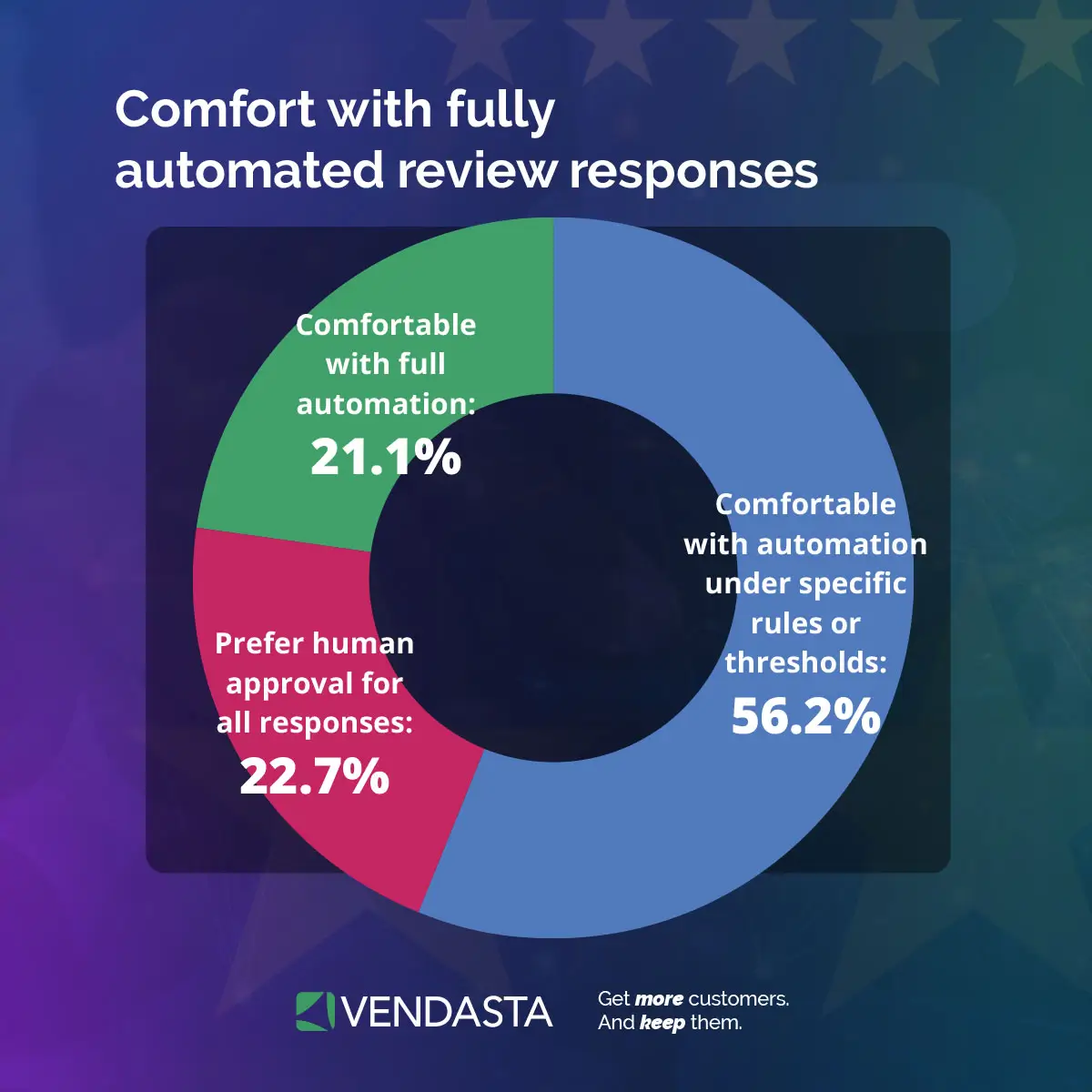
In Vendasta’s report, 56.2% of small businesses are comfortable with automated review responses under specific rules or thresholds, and 22.7% prefer human approval for every response. Only 21.1% are comfortable with full automation.
Search Engine Land’s analysis of AI in review handling found that “a hybrid approach is emerging as best practice”: the AI drafts and a person edits or approves. In practice, that means sending the five-star thank-you right away and holding the one-star complaint for the owner’s approval.
2. Growth Outcomes Matter More Than Crisis Management
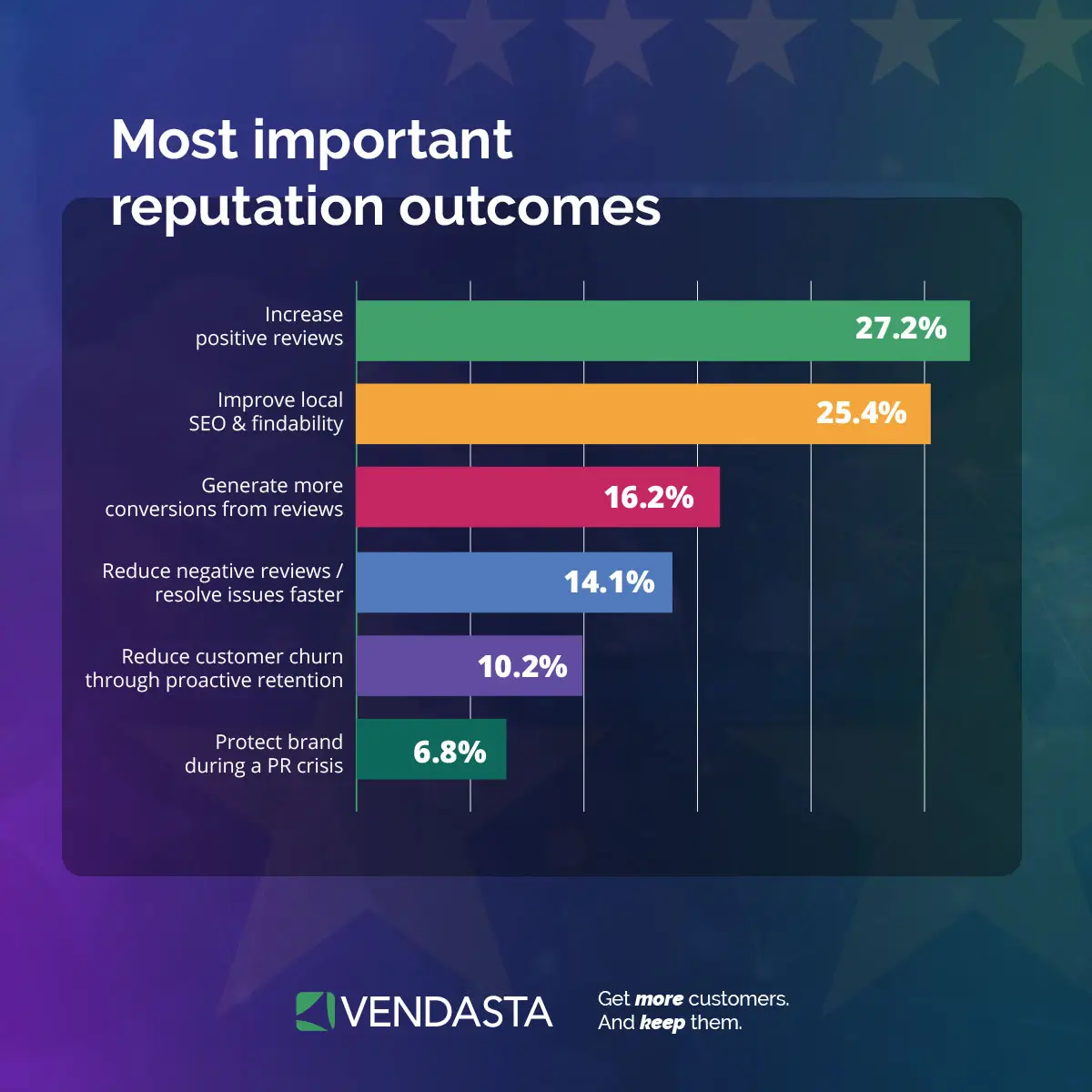
Asked what matters most, respondents in Vendasta’s report ranked increasing positive reviews first (27.2%), improving local SEO and findability second (25.4%), and generating more conversions from reviews third (16.2%). Reducing negative reviews and resolving issues faster followed at 14.1%, and reducing churn through proactive retention at 10.2%. Protecting the brand during a PR crisis ranked last at 6.8%, so reputation management now works more as a growth lever than as damage control.
Luca’s revenue data and Google’s ranking guidance both point to rating and volume as the levers, and LocalImpact’s survey shows owners measure the same things:
- 36% judge success by star-rating increase.
- 31% judge it by total review count.
- 10% judge it by inquiries and calls.
On crisis planning, 30% have no plan and 37% have only an informal one.
That ordering is defensible for a trade business, because a steady stream of new reviews pulls in jobs every week. The exposure is the day a fake one-star review lands, and there is no plan; LocalImpact’s survey found 62% of businesses have received at least one.
3. Speed and Protection Drive Value
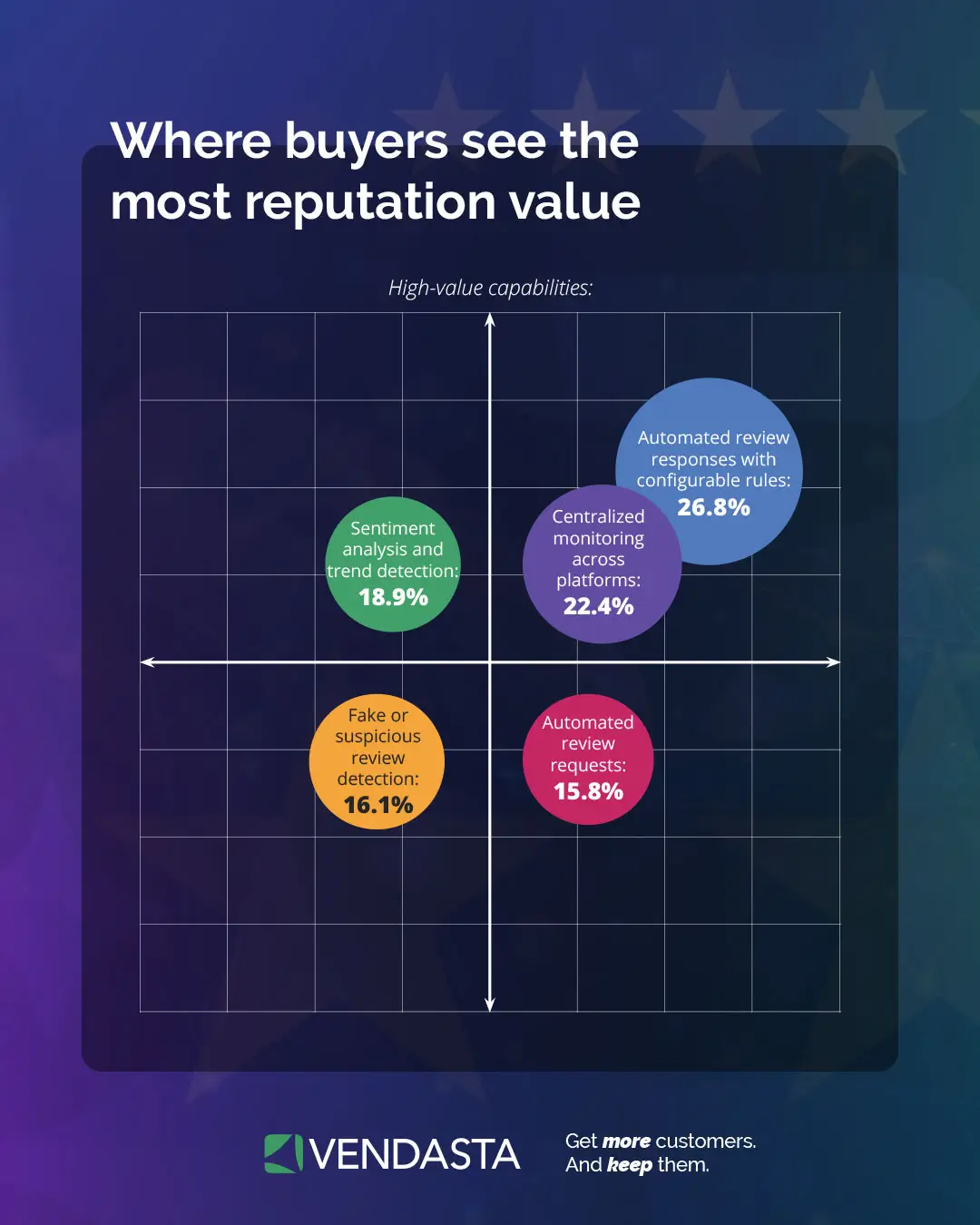
When respondents in Vendasta’s report rated high-value capabilities, automated review responses with configurable rules led at 26.8%, followed by centralized monitoring across platforms (22.4%), sentiment analysis and trend detection (18.9%), fake or suspicious review detection (16.1%), and automated review requests (15.8%). Insight without execution no longer counts for much.
Platforms and regulators are policing the system, which raises the cost of shortcuts. Google’s announcement reported 292 million policy-violating reviews blocked or removed in 2025 and 13 million fake Business Profiles taken down. The Federal Trade Commission (FTC) warning letters to 10 companies cited civil penalties of up to $53,088 per violation of the agency’s consumer review rule, which covers AI-generated reviews. Google’s policy also prohibits steering requests only to happy customers.
A growing share of consumers expect same-day replies. BrightLocal’s survey found 19% expect a response the same day, up from 6% a year earlier, and 32% expect one by the next day, up from 18%. A one-to-two-day reply already misses that same-day group.
What Small Businesses Actually Want From AI in Reputation Management
Vendasta’s report found two dominant priorities: faster, more consistent responses without hiring more staff, and earlier visibility into issues before they hurt trust.
Given how customers react, owners need AI that drafts in their own voice and stops at rules they set. The University of Arkansas study of health-care reviews found consumers could not tell undisclosed AI replies from human ones, reported lower satisfaction when they knew an AI had written the reply, and reacted less negatively when the business disclosed its own AI use than when the platform added a label. For a contractor, that means the reply must sound like you, and the rules about what goes out automatically are yours to set.
The hybrid model Search Engine Land describes, with AI drafting and a person approving, is how AI review responses work in practice: configurable rules decide which replies go out automatically and which you review first.
An AI reputation management agent differs from a chat tool you paste reviews into. Vendasta’s version is one of its AI Employees, drafting in the reviewer’s language and sending on your rules, working from the reviews Reputation AI monitors, whether or not you opened a laptop that day.
The Shift From Monitoring to Prevention
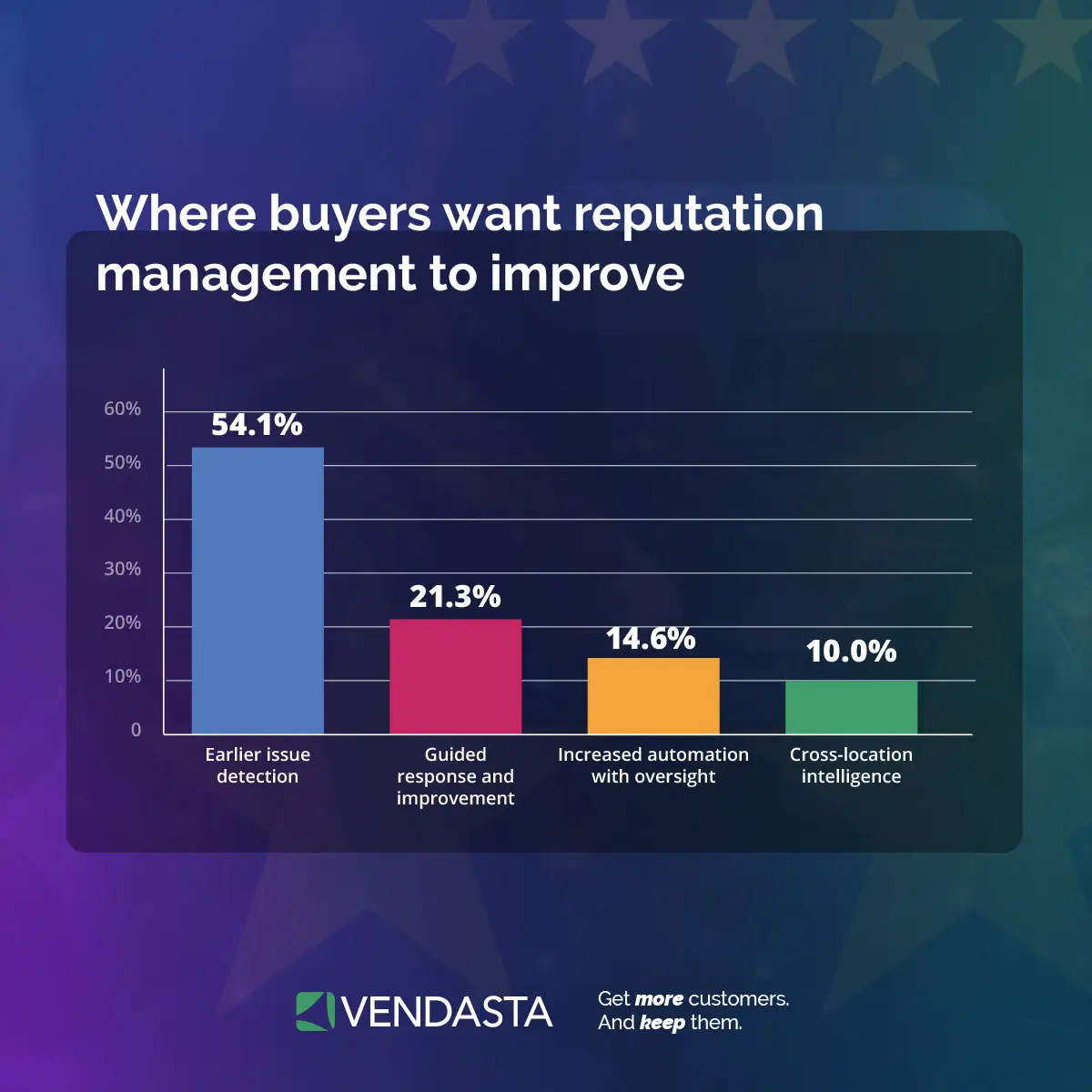
The strongest forward-looking signal in Vendasta’s report: 54.1% of small businesses want earlier issue detection, well ahead of guided response and improvement (21.3%), increased automation with oversight (14.6%), and cross-location intelligence (10.0%). Reputation problems rarely start as public crises. They start as patterns, like a recurring complaint, slipping sentiment, or slower replies, and catching those patterns early is the job.
Asking for reviews prevents the thin-profile problem before it starts. Gao and colleagues’ study in Management Science used a TripAdvisor natural experiment and found solicitation raised review volume by 34.3% and average rating by 0.151 points, with reviews 16.9% shorter.
A Journal of Marketing study of field experiments found an immediate reminder to review reduced posting while a delayed reminder increased it. Send the first request after the job, and space any reminders out rather than firing them immediately.
Prevention also means watching more than Google. A fake review or a competitor review-bombing your profile can sit unnoticed for weeks if nobody is watching. So can a stale listing on a directory you forgot about. Vendasta’s Reputation AI, the core of its AI reputation management approach, tracks 100+ sources, so a one-star review on any monitored site shows up in one place.
Listings are the other half of that visibility. You already claimed and verified your Google Business Profile in the quick-start steps, and that verification matters beyond the listing itself: Google requires a verified profile before you can reply to reviews, and each reply goes through a policy review that can take from 10 minutes up to 30 days. Plan for that lag when you draft your reply template.
Next, claim your profiles on Yelp, Apple Maps, and the trade directories homeowners use. That’s the core of listings management: keep your business name, phone number, hours, services, and service area identical everywhere, so a stale listing does not send a caller to an old number. Vendasta’s Listing Sync Pro keeps listings synchronized in real time across 50+ sites, with a United States premium tier covering 70+ sites.
Why Reputation Management Is Now an Execution Problem
Gao and colleagues’ study shows asking works: solicitation raised review volume 34.3%. LocalImpact’s survey found 62% of businesses ask actively, yet only 23% automate requests, and 52% cite customers forgetting.
That is the execution gap: the distance between knowing what a local business needs and being able to deliver it every day across fragmented tools and manual workflows. AI adoption among local businesses is growing, and review work suits it because the task repeats identically after every job.
Closing the gap means the review request goes out automatically after every job. Vendasta’s AI Reputation Specialist replies to Google and Facebook reviews under your rules and suggests replies for other sites, and you see a log of both without opening five tabs.
Review Reply Templates for the Five Hardest Cases
Reply within 24 hours on every platform, and keep each reply to three or four sentences in your own voice:
- Service failure: “Thanks for telling us, [Name]. We missed the mark on [specific issue], and that’s on us. Please call me at [number] so I can make it right.”
- Price complaint: “Thanks for the feedback, [Name]. Our pricing covers [licensed techs, warranty, parts], but I’d like to walk through your invoice with you. Call me at [number].”
- Staff conduct: “I’m sorry, [Name]. That’s not how we treat customers, and I’m addressing it with our team. Please reach me directly at [number].”
- False claim or not a customer: “We can’t find a record of this job under your name, [Name]. If we did work for you, please call [number] so we can look into it.” Then report the review.
- Glowing review: “Thank you, [Name]! Glad the [service] went smoothly, and we’ll pass your note along to [tech name].”
How Vendasta Helps Small Businesses Scale Reputation Management Safely
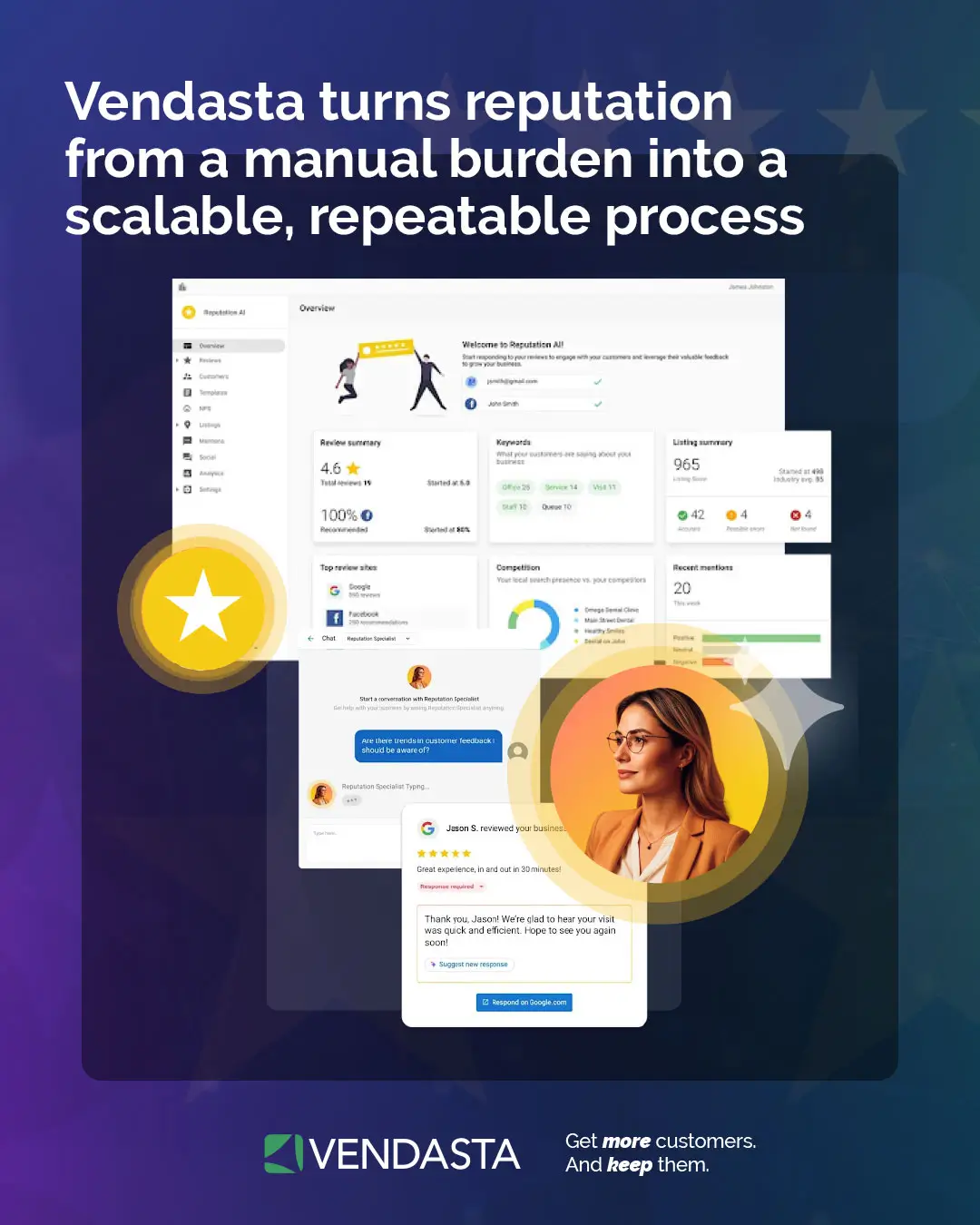
Vendasta splits the work between Reputation AI and AI Reputation Specialist.
1. Centralized Review Management
Reputation AI monitors reviews across 100+ sources in one dashboard, so you stop logging into Google, Facebook, and Yelp separately. It tracks sentiment shifts and spots patterns, and businesses with more than one location see every location in one place. You manage it from the Business App, alongside your CRM and unified inbox.
2. AI Reputation Specialist: Built-In Execution
AI Reputation Specialist automatically replies to Google and Facebook reviews in the reviewer’s language under rules you configure, and suggests replies for 100+ other review sites. You could set a rule so five-star thank-yous go out right away while anything under four stars waits for your approval. Most AI Employees learn from your website, business profile, and uploaded knowledge and deploy in under 30 minutes. Every action is logged, and done-for-you setup is available if you’d rather not configure it yourself.
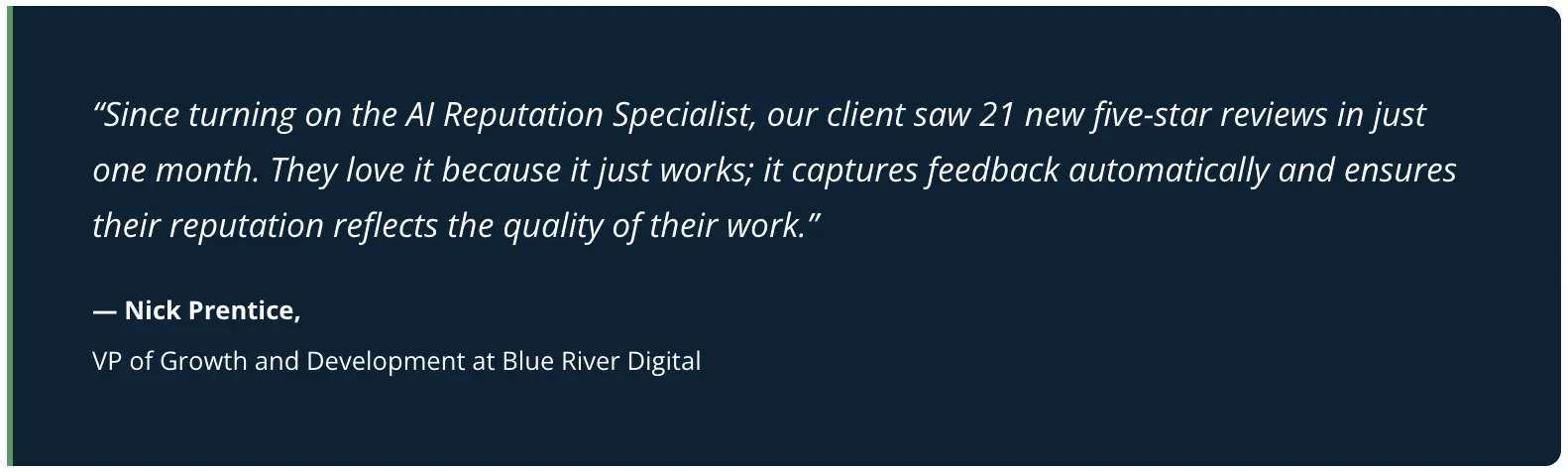
Vendasta’s auction-house success story reports that an auction-house client of Blue River Digital generated 21 five-star reviews in 30 days with AI Reputation Specialist.
3. Automated Review Requests and NPS
Reputation AI sends review requests by email or SMS after each job, plus net promoter score (NPS) surveys that identify promoters and catch unhappy customers early. It integrates with Jobber, QuickBooks Online, and PetExec, so requests can trigger from jobs you already close out, and review-response automation handles the replies.
Vendasta’s case study reports that Fred Astaire Dance Studios averaged 50 reviews per store. Search traffic grew 37%, and units using Vendasta’s tools generated 2.5 times more net-new leads.

4. AI Chat Insights That Drive Action
Reputation AI’s sentiment analysis reads each incoming review, so you can see whether feedback is trending positive or negative. You can also ask AI Reputation Specialist plain-language questions, like “What are customers complaining about this month?”, and get a recommended next step. A Friday check gives you an agenda for the Monday crew meeting.
5. Social Comments and Messages in One Inbox
Answering customers on social channels is part of reputation management, and so is social listening: tracking what people say about your business in comments and messages. Both belong in your weekly routine.
DJS Research’s survey of UK businesses found that, among those affected by negative online content, 71% named negative social media as the most damaging and 52% named negative reviews. A complaint in a Facebook comment or Instagram message needs the same fast answer as a review, so add public Facebook and Instagram comments to your weekly check.
Conversations AI brings Facebook Messenger and Instagram messages into one unified inbox, logging every conversation to the CRM. AI Receptionist, unlocked by Conversations AI, answers messages around the clock.
Reputation Management for Small Businesses in 2026 and Beyond
Consumers are spreading their review activity beyond Google. BrightLocal’s survey found consumer use of Google for local reviews dipped from 83% to 71% in a year, while Apple Maps use nearly doubled from 14% to 27%, and 41% of consumers now say they always read reviews, up from 29%.
Regulators and platforms are tightening enforcement. The FTC’s consumer review rule covers AI-generated reviews, and Yelp’s policy bars reviewers from using third-party AI tools to write reviews. The legitimate path, asking real customers after real jobs and replying in your own voice, is also the path that scales.
A routine that holds up in 2026:
- Automate the review request.
- Set reply rules so praise is answered within hours, and complaints reach you first.
- Keep a log you can read in five minutes.
How to Get a Fake Review Removed From Google or Yelp
Removal depends on platform policy. Google’s Maps policy says contributions should reflect a genuine experience and that fake engagement is not allowed and will be removed. It also prohibits paid or incentivized reviews and posting on a competitor’s listing. Report the review to the platform and name the rule it breaks.
Google’s guidance describes review-bombing extortion as a sudden increase in one- and two-star reviews followed by a demand for money, goods, or services. Screenshot the reviews and any demand before reporting them.
Yelp’s trust and safety report shows it removed over 193,700 community-reported reviews and more than 80,000 reviews for not reflecting firsthand experiences in 2025. While a report is pending, post a short, factual public reply. Monitoring through Reputation AI surfaces these reviews early.
The Five Numbers to Track
Check these monthly to know your reputation work is paying off:
| Metric | Target | Why it matters |
|---|---|---|
| Average star rating | 4.0 or higher | 68% of consumers require four stars or better |
| Total reviews | 20+, then keep climbing | 47% of consumers won’t use a business with fewer than 20 |
| New reviews per month | Some every month, so your newest is never stale | 74% of consumers only care about reviews from the last three months |
| Response rate | 100% of reviews | 89% of consumers expect owners to respond |
| Time to first response | Within 24 hours | 32% of consumers expect a reply by the next day, and 19% the same day |
Download the 2026 State of Reputation Management Report
This article covers the headline numbers. The full report includes complete survey findings, industry breakdowns, detailed AI adoption insights, and deeper analysis of reputation as a growth channel.
Download the 2026 State of Reputation Management Report
The Bottom Line: From Monitoring to Mastery
The crew finishes a furnace install at 4 p.m., nobody sends a request, and the homeowner forgets by dinner. Across town, last week’s one-star complaint still has no reply. Owners already know reviews drive jobs, and the execution gap lives in those unsent requests and unanswered complaints.
Reputation AI monitors 100+ sources and sends review requests after every job, and Vendasta’s AI Reputation Specialist replies to Google and Facebook reviews under your rules. You can run it yourself with a done-for-you setup or have a marketing agency manage it for you.
You keep the voice and the approval rights. Request a demo of Vendasta today.
Reputation Management for Small Businesses FAQs
1. What is reputation management for small businesses?
Online reputation management for a small business is the ongoing cycle of requesting reviews, answering each one, and checking listings and review sites for errors, fake reviews, and complaints. For a local service business, it also covers Google Business Profile accuracy, since that profile appears in local search.
2. Why is reputation management important for small businesses?
Reviews affect revenue and visibility in specific contexts. Luca’s restaurant study tied one extra star to 5–9% more revenue for independents, and Google says more reviews and positive ratings can help local ranking. BrightLocal’s survey found 47% of consumers pass over businesses with fewer than 20 reviews.
3. How does AI improve reputation management for small businesses?
You can assign the repetitive work to AI. Reputation AI monitors 100+ sources, analyzes sentiment, and sends review requests and NPS surveys. AI Reputation Specialist replies to Google and Facebook reviews in the reviewer’s language under your rules and suggests replies for other sites. Each action is logged, so you can check what went out.
4. Do small businesses really need reputation management software?
Managing by hand works for local businesses with few reviews, and Search Engine Land’s guide calls that the exception. Once a crew finishes several jobs a day, software saves time by sending requests automatically and catching reviews on sites you never visit. In Vendasta’s 2026 report, 62.6% of small businesses still rely mainly on native review platforms, which is where reviews get missed.
5. How do online reviews affect local SEO?
Google’s guidance says more reviews and positive ratings can help local ranking and that replying helps a business stand out. Local Falcon’s analysis found the median plumber in Google’s 3-Pack had 215 reviews. Correlation studies associate review count and rating with Local Pack position, though Google publishes no weights.
6. What is the best way to respond to negative reviews?
Use a hybrid approach: let AI draft the reply, then have the owner edit or approve it before sending. Search Engine Land describes that workflow as best practice. It keeps a person responsible for the final response when a complaint requires judgment.
7. How can small businesses get more positive reviews?
Ask every customer after every job, automatically. Gao and colleagues’ study found solicitation raised review volume 34.3% and average rating by 0.151 points. Vendasta’s Reputation AI sends email or SMS requests. Space any reminder out rather than sending it immediately, since the Journal of Marketing study found delayed reminders increased posting.
8. What are the biggest challenges in reputation management for small businesses?
Time and coverage are the biggest challenges for an owner running jobs all day. LocalImpact’s survey found 52% of businesses cite customers forgetting as an obstacle, and 62% have received at least one fake review.
9. Can reputation management help reduce customer churn?
No available study measures a local business’s own rating against its churn, so treat any vendor claim with care. In Vendasta’s 2026 report, 10.2% of small businesses named reducing churn through proactive retention as their most important reputation outcome. The closest outside evidence is stated intent: BrightLocal’s survey found 80% of consumers are likely to use a business that responds to all reviews and 42% are unlikely to use one that never replies.
10. How do I choose the right reputation management platform for my business?
Ask whether it monitors more than Google and whether it sends requests from data in tools you already use. Then check whether you can set rules for automatic replies and review a log of every action. Vendasta Reputation AI and AI Reputation Specialist cover all four checks.
This article was originally published in February 2026 and was updated in October 2026 to include the latest information and insights.
