About Us
 Careers
 Leadership
 Board
Board Newsroom
A homeowner fills out a quote request for a house cleaning at 9:47 p.m. Nobody calls back until the following afternoon. By then, she has already booked with a competitor who answered first.
Now multiply that single missed moment across a franchise network with 50, 100, or 300 locations. Franchisees are on job sites, dealing with a flat tire, an employee who called in sick, or a washer buzzing in the background. Leads fall through the cracks not because anyone is careless, but because nobody has the bandwidth to catch every single one.
The fix does not start with hiring a bigger call center or micromanaging every location. It starts with understanding a metric called speed to lead, and closing the gap with AI Employees that respond to every lead, at every location, the moment it comes in.
This article breaks down what speed to lead means, why it is quietly draining revenue from franchise networks, and how a 40-year-old home services brand used AI to fix it network-wide, without adding headcount at a single location.
Capture, qualify, and convert leads 24/7 without lifting a finger
TL;DR
- Speed matters more than volume: Leads contacted within five minutes convert dramatically better than leads contacted an hour later.
- Franchises leak leads twice: Once after-hours when nobody answers, and again when captured leads never get followed up.
- AI closes both gaps at once: One brand used AI to handle over 200,000 customer conversations a year without adding staff.
What Is Speed to Lead?
Speed to lead is the amount of time that passes between a prospect showing interest in your business and the moment you respond. That interest might be a web form, a missed call, a text message, or a chat window. The clock starts the second they reach out, not when someone gets around to checking the inbox.
It goes by a few other names in sales and marketing circles: lead response time, time to first contact, or response speed. All of them describe the same gap, and all of them are measured in minutes, not days.
How Is Speed to Lead Measured?
Most teams calculate it simply: the timestamp of first outbound contact minus the timestamp of lead capture. A lead that fills out a form at 2:00 p.m. and gets a callback at 2:04 p.m. has a four-minute speed to lead.
The challenge for franchise networks is that this number varies wildly by location. One franchisee might respond in minutes. Another, buried under service calls, might not respond for a day. Corporate rarely has visibility into which is which until the booking numbers already show it.
Why Speed to Lead Matters for Franchise Networks
The research on this has been consistent for over a decade. A widely cited Harvard Business Review study found that companies attempting to contact a lead within the first hour were nearly seven times more likely to have a meaningful conversation than those that waited even one hour longer.
The decay curve after that is steep. Industry research summarized by Chili Piper found that qualification odds can drop by roughly 80% after just five minutes, and that 78% of B2B buyers purchase from whichever vendor responds first. Meanwhile, LeanData’s research puts the average B2B response time at a staggering 42 hours.
| Response Time | What It Means for Conversion |
|---|---|
| Within 5 minutes | Highest odds of a meaningful conversation and a booked appointment |
| Within 30 minutes | Qualification odds have already dropped sharply |
| 1 hour or more | The lead has likely already contacted, or booked with, a competitor |
| 42 hours (B2B average) | Typical response time for companies without an automated system |
For a franchise network, this is not an abstract sales statistic. Every location generates leads through corporate-funded marketing, local SEO, and paid ads. Every minute of delay is corporate marketing spend quietly evaporating at the franchisee level.
The Hidden Cost: Franchises Have a Leaky Bucket, Not Just a Missed-Call Problem
Most conversations about franchise lead loss focus on after-hours calls. That is the visible symptom. The bigger problem is what happens to leads that do get captured.
According to research cited by Salesforce, up to 30% of captured leads in many organizations sit in the pipeline without ever being engaged. These are not cold strangers. They already requested a quote, filled out a form, or asked a question. They showed real intent, and then nothing happened.
Franchise networks leak leads in several places at once:
- After-hours calls and web chats that go unanswered while franchisees are off the clock
- Abandoned web forms where a prospect started but never finished, a gap that stronger automated lead capture is built to close
- Third-party lead sources that route in without a consistent follow-up process, the kind of inconsistency that dedicated franchise lead management software is designed to fix
- Mid-funnel and bottom-funnel leads who inquired, got a quote, or asked about pricing but never booked
Separately, missed calls alone are a massive problem. Research from Invoca found that businesses miss up to 62% of their inbound calls. An AI phone receptionist can close much of that gap on its own, but across a network of 100 locations, even a partial fix adds up to a genuinely painful amount of recovered revenue every single month.
How Molly Maid Fixed Its Speed-to-Lead Problem With AI
Few franchise brands have talked as openly about this problem as Molly Maid, the residential cleaning brand under the Neighborly umbrella. On a recent industry webinar hosted by the International Franchise Association, Molly Maid brand president Michael Silva-Nash and franchise systems manager Jacqueline Drury walked through exactly how the brand tackled it.
Vendasta + IFA Webinar Series | No Lead Left Behind: How Molly Maid Put AI on the Front Line
The starting point was a research project that Molly Maid ran roughly two years ago. It found that close to 30% of leads, across both digital channels and phone calls, were being missed entirely. Silva-Nash described the underlying issue plainly: franchisees are busy running real businesses, so leads that should feel urgent often do not.
The brand also knew the data on response speed. As Silva-Nash put it, “time kills all deals,” and the odds of closing a lead drop dramatically once you pass the thirty-minute mark. That understanding, combined with an existing relationship with Vendasta, is what pushed Molly Maid to build what became known internally as Rosie.
Meet Rosie: An AI Employee With a Personality
Rosie started small, as a web chat widget trained to answer FAQs. It expanded into automated text messaging for franchise leads, then into handling leads from third-party sources. Today, Drury described Rosie as a genuine part of the team.
“She sounds very real,” Drury explained on the webinar, noting that Rosie references personal details customers mention and responds the way a real customer service rep would. That kind of personality does not happen by accident. It comes from deliberate AI receptionist prompting long before a customer ever says hello. Rosie also connects directly to each location’s point-of-sale system to check real-time pricing and availability before booking a job.
That matters because customer behavior has shifted. As Drury put it, plenty of customers do their planning late at night: “somebody’s, you know, worked all day, came home, dealt with the kids, and then at night, 11:00 at night… they go online, and they can just book something right then and there.”
The Scale of the Results
During the webinar, the Vendasta team shared a figure that puts the scale of this problem, and the opportunity, into perspective: roughly 5,000 bookings a month against approximately 210,000 conversations a year, working out to a conversion rate in the neighborhood of 15%.
That is 210,000 customer interactions annually that no longer depend on a franchisee being available to pick up the phone.
Corporate Sets the Standard, Franchisees Keep Local Control
One detail worth highlighting for anyone managing a multi-location marketing program: Molly Maid trains Rosie once, centrally, and deploys that training to every location, the kind of rollout that relies on the right digital tools for franchise management. Franchisees can still make local adjustments, like whether their location participates in the Miss Molly Foundation or how it handles a city-specific parking surcharge, without touching the rest of Rosie’s core knowledge base.
Silva-Nash summed up the philosophy behind the rollout: “It’s how do you do it, how do you get smart about it, but don’t lose that high-touch part of your business by going high-tech.” That balance, corporate consistency without losing the local, human relationship, is exactly what makes AI deployment work at franchise scale.
How Does AI Improve Speed to Lead in Sales Processes?
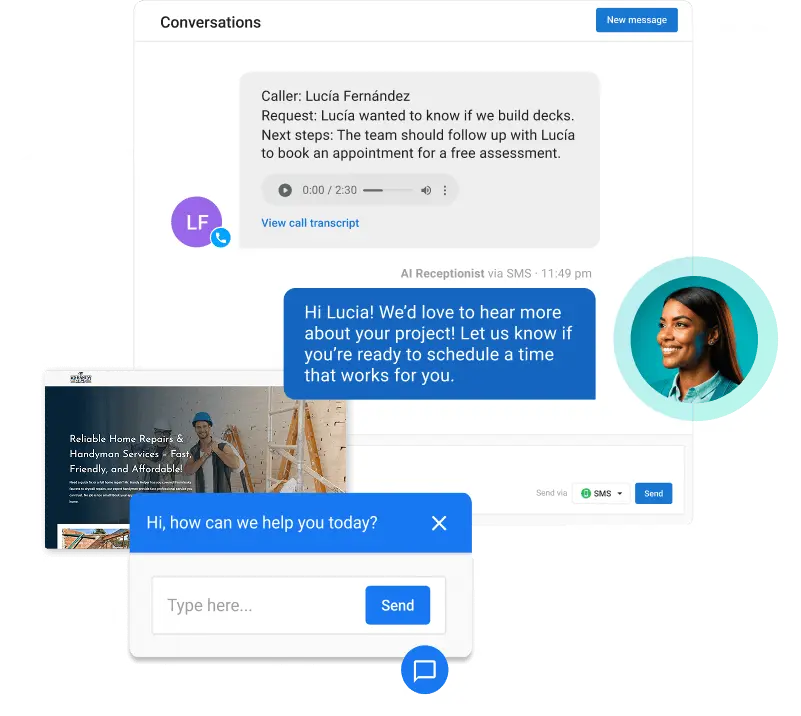
AI improves speed to lead by responding to every lead instantly, across every channel, without waiting for a human to become available. Instead of a lead sitting in a queue until a rep has time, an AI employee engages the moment someone reaches out.
In practice, this plays out in a few specific ways:
- Instant, 24/7 response. An AI Receptionist answers phone calls, web chat, and SMS around the clock, compressing response time from hours or days down to seconds.
- Automated follow-up for stalled leads. Rather than letting mid-funnel leads go cold, AI lead nurturing sequences re-engage prospects who inquired but did not book.
- Live system integration. Connecting to a location’s point-of-sale or scheduling software lets AI quote real pricing and availability instead of just taking a message.
- Central training, local flexibility. One playbook trains the AI network-wide, while individual locations can still adjust for their market.
- A clear handoff to humans. When AI does not have an answer, the conversation routes straight to the franchisee or a call center rather than guessing.
Vendasta’s own Conversations AI has driven a 372% increase in lead-to-revenue conversion for businesses that deploy it, largely because it eliminates the delay between first contact and meaningful engagement.
How to Improve Speed to Lead Across Your Franchise Network
Here is a practical, step-by-step approach for corporate marketing teams looking to close the speed-to-lead gap network-wide.
- Audit your current lead flow. Map how leads enter the system today, at both the network and location level, and how long each one waits for a response.
- Set the standard once. Document response scripts, follow-up cadences, and brand voice guidelines centrally so every location starts from the same playbook.
- Deploy an AI receptionist network-wide. Cover phone, web chat, and SMS so no channel depends on a franchisee being at their desk.
- Automate follow-up for existing leads. Use AI lead scoring to target the mid-funnel and bottom-funnel prospects who already showed interest but never converted.
- Build in local flexibility. Let franchisees adjust the details that matter to their market without touching the core training.
- Pilot before a full rollout. Test with five to ten locations, refine based on what works, and use those early results to build buy-in across the rest of the network.
- Monitor performance at every level. Track speed to lead, booking rates, and conversion by location so corporate can spot and support underperforming franchisees quickly.
What to Look for in a Speed-to-Lead Solution for Franchises
Not every tool built for a single-location business will hold up across a network of 20, 50, or 300 locations. When evaluating a solution, look for:
- Omnichannel coverage. Phone, SMS, web chat, and third-party leads should all funnel into one system.
- Centralized deployment. One training, one rollout, applied instantly across every location rather than location-by-location setup.
- Franchisee-level flexibility. Corporate sets the standard, but locations should be able to fine-tune details relevant to their market.
- Integration with existing systems. The AI should connect to the point-of-sale, scheduling, or broader franchise management software franchisees already use.
- Transparent, location-level reporting. Corporate needs to show ROI to leadership and to individual franchisees, not just at the network level.
This is the exact gap Vendasta’s AI Workforce is built to close for franchise brands. Corporate trains AI Employees, like an AI Receptionist or AI Sales Assistant, once, and Vendasta deploys that training to every location at once, all from a single platform instead of a patchwork of disconnected vendors.
For partners managing dozens or hundreds of locations, that means less time stitching together reports and more time proving, with real numbers, that the network’s marketing spend is converting into booked jobs.
Conclusion
Speed to lead is not a vanity metric. It is the difference between a franchise network that converts the leads it already paid to generate and one that quietly loses them to a competitor who simply answered first. Molly Maid’s experience shows what is possible when a brand treats this as a network-wide problem instead of a franchisee-by-franchisee inconvenience: corporate set the standard once, deployed AI to enforce it everywhere, and turned hundreds of thousands of yearly conversations into booked revenue without adding a single new hire at the location level. For franchise marketing leaders building out a broader home service franchise marketing strategy, the real question is simpler: how much longer can your network afford to let leads sit?
Book a demo with Vendasta today!
Speed to Lead FAQs
1. What is speed to lead?
Speed to lead is the time between when a prospect shows interest, through a call, text, or web form, and when your business responds. Shorter response times consistently lead to higher conversion rates, which is why it has become a core metric in both B2B sales and local service businesses.
2. Why does speed to lead matter for franchise networks?
Franchise networks generate leads through corporate-funded marketing, but franchisees are often too busy running day-to-day operations to respond quickly. Slow response times waste that marketing spend. Closing the gap network-wide, rather than location by location, is what actually protects the return on that investment.
3. What is a good speed to lead benchmark?
Most research points to five minutes as the target for the highest conversion odds, with results dropping sharply after 30 minutes. The average B2B company takes closer to 42 hours to respond, which highlights just how large the opportunity gap is for businesses that respond faster.
4. How is speed to lead measured?
It is calculated as the time between a lead’s first contact, such as a form fill or missed call, and the business’s first meaningful response. Many franchise networks track this at both the network level and the individual location level to spot inconsistent performance.
5. How does AI improve speed to lead in sales processes?
AI improves speed to lead by responding to leads instantly across phone, chat, and text, without waiting for a person to be available. Vendasta’s AI Employees, like the AI Receptionist, engage leads the moment they reach out and can hand off to a human when needed.
6. Can AI handle speed to lead for multiple franchise locations at once?
Yes. Platforms like Vendasta allow corporate teams to train an AI employee once and deploy it across every location simultaneously. Franchisees can still adjust local details, but the core response speed and quality stay consistent network-wide, which is difficult to achieve manually.
7. What is the difference between speed to lead and lead response time?
The two terms are largely interchangeable and are often used to describe the same thing: how quickly a business responds to a new lead. Some teams use lead response time for phone-specific metrics and speed to lead as the broader, channel-agnostic term.
8. How much revenue is lost from slow speed to lead?
It varies by business, but research shows up to 30% of captured leads in many organizations never get meaningfully engaged, and businesses miss as many as 62% of inbound calls. Across a franchise network, that adds up to a significant amount of recoverable revenue.
9. Does Vendasta help franchises improve speed to lead?
Yes. Vendasta’s AI Workforce, powered by Conversations AI, gives franchise networks an AI Receptionist that answers calls, chat, and texts 24/7 across every location. Corporate sets the standard once, and Vendasta deploys it everywhere, closing response gaps without adding staff at the location level.
10. What tools improve speed to lead for franchise networks?
The most effective tools combine an AI receptionist, automated follow-up sequences, and centralized reporting in a single platform. Vendasta’s AI Employees cover all three, connecting to the systems franchisees already use so no lead, after-hours or mid-funnel, falls through the cracks.